

Last updated: October 2026. Canadian prices checked on October 11, 2026, before tax.
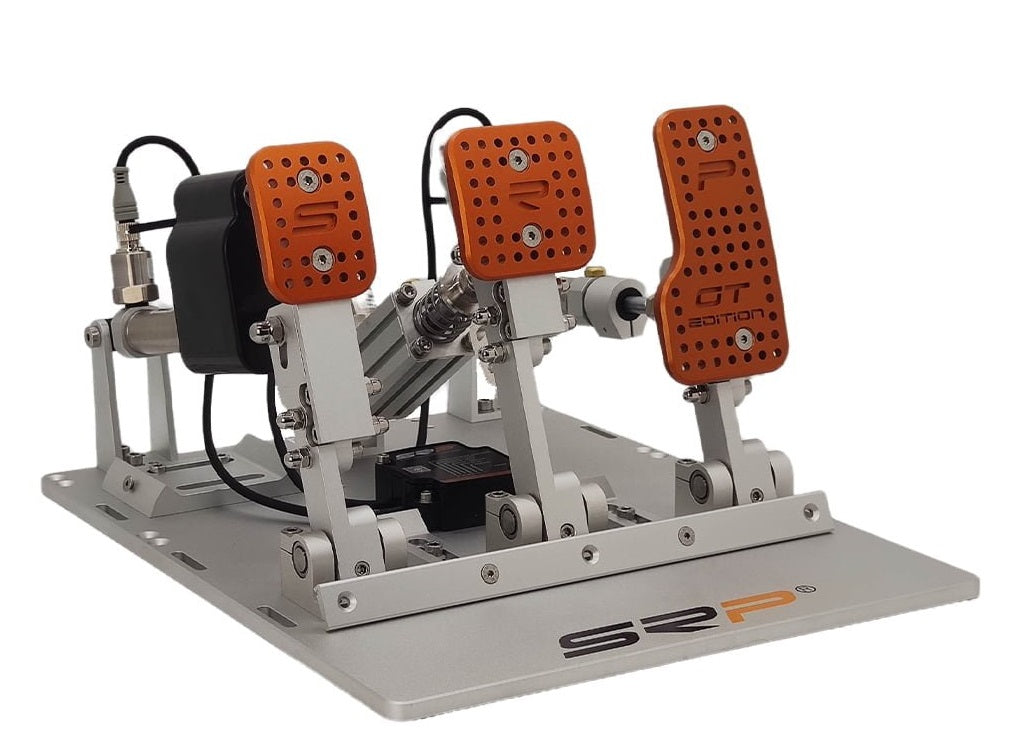
If you are looking at SRP pedals, you already know what you want: a brake that responds to the pressure of your foot, like a real car, and pedals you will not need to replace in two years. What is left is choosing between the Spanish brand's two platforms, the GT-R and the GT-S. They share the same pneumatic core; everything else comes down to how you race and what you plan to add later.
THE SHORT ANSWER
- Both are pneumatic: an air cylinder under the brake, 65,536-step resolution, CNC-machined aluminium and a USB-C connection to your PC. The core brake feel comes from the same family.
- GT-S: SRP's entry point, from CA$992 for 2 pedals. Independent pedals, three layouts (A, B, C) and modules you add as needed: base plate, brake travel regulator, heel rest.
- GT-R: the complete platform, from CA$1,323. Base plate included, more pedal layouts and, above all, the GTI-R conversion to hanging pedals, as in most single-seaters and modern GT cars.
- Our take: GT-S if you mount on an aluminium profile rig and want the best brake for the money; GT-R if you race formula or modern GT, or want a platform that will follow every upgrade.
- Both are built to order in Spain in 15 days and shipped directly from the SRP factory. PassionSim is SRP's official Canadian distributor.

Pneumatic: what changes under your foot
An entry-level pedal set measures the pedal's position. A load cell pedal set measures the force you put into it. Pneumatic goes one step further in feel: an air cylinder replaces the spring or elastomer, and air compresses progressively. The pedal firms up as you press, without the hard wall an elastomer hits at the end of its travel.
The result works on the same principle as a real brake or a hydraulic pedal: the brake responds to pressure, not to how far the pedal moves. Your brain remembers an effort rather than a position, which is what lets you hit the same braking point lap after lap, even when you are tired. With 65,536 steps of resolution, the signal is fine enough to feel the lock-up threshold through your foot.
| Load cell | Hydraulic | Pneumatic (SRP) | |
|---|---|---|---|
| What resists | Spring or elastomer | Fluid in a master cylinder | Compressed air in a cylinder |
| Force build-up | Depends on the elastomer | Progressive, then very firm | Progressive, cushioned end of travel |
| Maintenance | Elastomers wear over time | Fluid and seals to watch | No fluid |
| Best for | The first real jump in realism | The most car-like feel | Long stints and consistency |
For the full breakdown of the four technologies (Hall effect, load cell, hydraulic, pneumatic), see our pedal buying guide.
GT-R vs GT-S: the differences at a glance
| SRP GT-S | SRP GT-R | |
|---|---|---|
| Positioning | The modular platform, SRP's entry point | The complete platform |
| Starting price (2 pedals, grey) | CA$992 | CA$1,323 |
| 3-pedal price (grey) | CA$1,290 | CA$1,665 |
| Brake system | Pneumatic, 65,536 steps | Pneumatic, 65,536 steps |
| Base plate | Optional (CA$82) | Included |
| Pedal layouts | A, B or C (2-pedal sets) | Up to 4 layouts |
| Hanging pedals (GTI-R) | — | Yes, with the inversion kit |
| Brake travel regulator | Yes | Yes |
| Foot rests, vibration kit, long pedals | Yes | Yes |
| Finish | Grey or black, 8 plate colours | Grey or black, 8 plate colours |
| Build | Made to order, 15 days | Made to order, 15 days |
Prices in Canadian dollars, grey finish, before tax, checked on October 11, 2026. The black finish adds CA$90 to CA$160 depending on the configuration.
In other words, the GT-S is not a "small" GT-R. The brake comes from the same family. What the GT-R adds is a more complete platform out of the box (base plate, layouts) and a path to the hanging geometry the GT-S does not offer.
Who is the GT-S for?

The GT-S is built for modularity. Its pedals are independent: you choose the spacing between throttle, brake and clutch, and bolt each one straight onto your cockpit's aluminium profile. Three layouts marked A, B and C change the spacing and the depth offset: tight for heel-and-toe in rally, wider in endurance so thick shoes never catch two pedals at once.
It suits you if:
- your cockpit is built from aluminium profile (6Sigma, 80/20 or similar) and you want to put each pedal exactly where you want it;
- you are moving from a load cell to a pressure-based brake and want the best feel for the money in the lineup;
- you would rather add modules one at a time, as you need them.
The first addition to consider is the base plate (CA$82). It spreads braking loads over a wide surface instead of a few bolts: on a brake you modulate by pressure, any play in the mounting turns into a braking point that drifts. The brake travel regulator (CA$105) then sets how far the pedal moves before full pressure: short for a threshold brake like a single-seater, longer for a progressive build-up that is easier to modulate in endurance.
Who is the GT-R for?
The GT-R comes with its base plate, more pedal layouts and one thing the GT-S cannot do: the inversion kit, which turns it into a GTI-R. The pedals then hang from the top, as in most single-seaters and modern GT cars. If you race formula, the motion becomes the real car's: your heel stays on the floor and the pedal comes to you.
It suits you if:
- you race formula, prototypes or GT3 and want hanging pedals, now or later;
- your cockpit has no aluminium profile pedal deck and you want a rigid base supplied;
- you want one platform that will follow every upgrade, without reselling.
The question to ask yourself
Will you ever race with hanging pedals? If the answer is "maybe", get the GT-R: it is the only one of the two that allows it. If it is "no", the GT-S gives you the same type of brake for about CA$330 less.
The options that are actually worth it
Both pedal sets are configured piece by piece in our configurators (GT-R, GT-S). Not every option is equal; here is our order of priority.
| Option | Price | For | Our take |
|---|---|---|---|
| Heel rest kit (GT-R) / ergonomic heel rest (GT-S) | CA$115 / CA$62 | Endurance, long sessions | The best value add. Your foot pivots instead of holding itself up. |
| Brake and throttle foot rests | CA$44 each | Everyone | A fixed pivot point: modulation moves from your leg to your ankle. |
| Vibration kit | CA$252 | Drivers who want to feel ABS and lock-up | Sends the onset of lock-up and wheelspin right under your sole. Useful, not essential. |
| GTI-R inversion kit (GT-R only) | CA$329 | Formula, modern GT | For many drivers, the reason to buy the GT-R. |
| Long pedals | CA$35 to CA$56 | Tall drivers, shared cockpits | Widens the height adjustment range. |
| Plate colour | CA$41 | The style-conscious | Anodized: it protects the aluminium as well as dressing it. |
Prices in Canadian dollars, grey finish, checked on October 11, 2026.
Two or three pedals?
The clutch adds about CA$300 (GT-S) to CA$340 (GT-R). It is only worth it if you drive with an H-pattern shifter (historic cars, rally, drift) or want to handle standing starts yourself. In GT3, formula or prototypes, with paddles and a sequential gearbox, two pedals are enough, and you can always add the clutch later. Our pedal guide walks through the reasoning.
Mounting, software and compatibility
Both pedal sets plug straight into your PC over USB-C, independently of your wheelbase: they work with a Conspit, Moza, Simagic or any other base. SRP's software offers PRO and CUSTOM modes for deadzones, response curves, ABS and autobrake, so you can switch between a reference setup and your own without recalibrating everything.
On the cockpit side, a pneumatic brake needs a rigid mount. An aluminium profile rig is ideal; a light tubular stand may flex at full pressure. If you are unsure about your rig, our cockpit guide compares the options.
What an SRP pedal set really costs in Canada
A realistic setup, the way most of our customers order it, looks like this:
| Typical setup | GT-S | GT-R |
|---|---|---|
| 2-pedal set, grey | CA$992 | CA$1,323 |
| + base plate | CA$82 | included |
| + heel rest | CA$62 | CA$115 |
| + brake foot rest | CA$44 | CA$44 |
| Total | CA$1,180 | CA$1,482 |
Prices in Canadian dollars, before tax and shipping, checked on October 11, 2026.
Each pedal set is built to order in Spain, with a 15-day build time, then shipped directly from the SRP factory. Instalment payments are available at checkout through Shop Pay; the terms are shown in the configurator before you confirm.
Configure your SRP pedal set
Start from the base, add only what serves your driving, and watch the total update live.
Choose GT-R or GT-S Configure the GT-S Configure the GT-ROur verdict
If you mount on an aluminium profile rig and do not plan to switch to hanging pedals, the GT-S is the rational choice: the same type of pneumatic brake, pedals you place wherever you want, and about CA$300 of difference on a complete setup. If you race formula or modern GT, or want a platform you will never have to replace, the GT-R earns its price with the included base plate and the GTI-R conversion.
Still on the fence? Send us your cockpit and your discipline, and we will tell you which one to get.
Frequently asked questions
What is the difference between the SRP GT-R and GT-S?
Both are 65,536-step pneumatic pedal sets in machined aluminium. The GT-S (from CA$992) has independent pedals, three layouts and optional modules. The GT-R (from CA$1,323) includes the base plate, offers more layouts and can be converted to a GTI-R with hanging pedals.
Are pneumatic pedals better than load cell pedals?
They are a step up in feel. Like a load cell, they respond to force, but the air compresses progressively, which gives a more natural build-up and a cushioned end of travel, close to a hydraulic brake, with no fluid to maintain.
Do SRP pedals work on PS5 or Xbox?
They connect to a PC over USB-C. They are not licensed for consoles.
Can a GT-S be converted to hanging pedals?
No. The GTI-R hanging geometry is specific to the GT-R and its inversion kit.
How long does it take to get an SRP pedal set?
Each pedal set is built to order in Spain with a 15-day build time, then shipped directly from the SRP factory. Add transit time on top.
Where can I buy SRP pedals in Canada?
At PassionSim, SRP's official Canadian distributor.
Written by the PassionSim team, a Canadian sim racing store. We sell, build and drive this gear every day — send us your questions or come try a simulator in store.