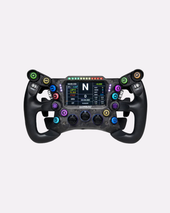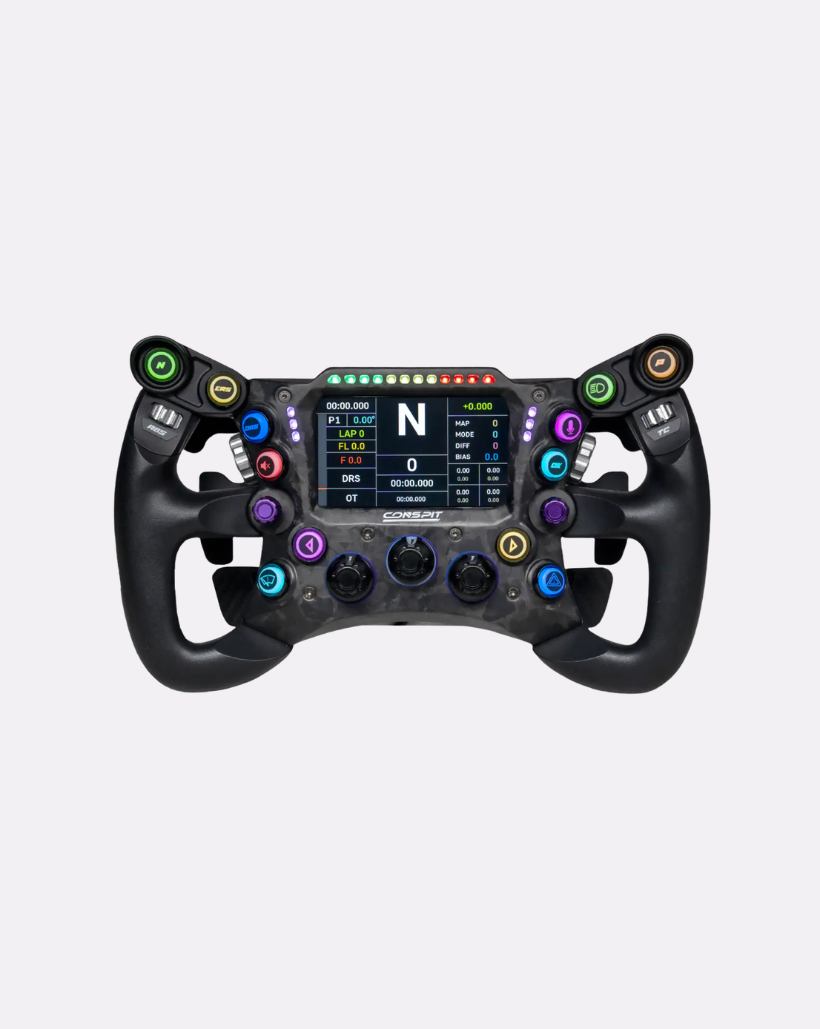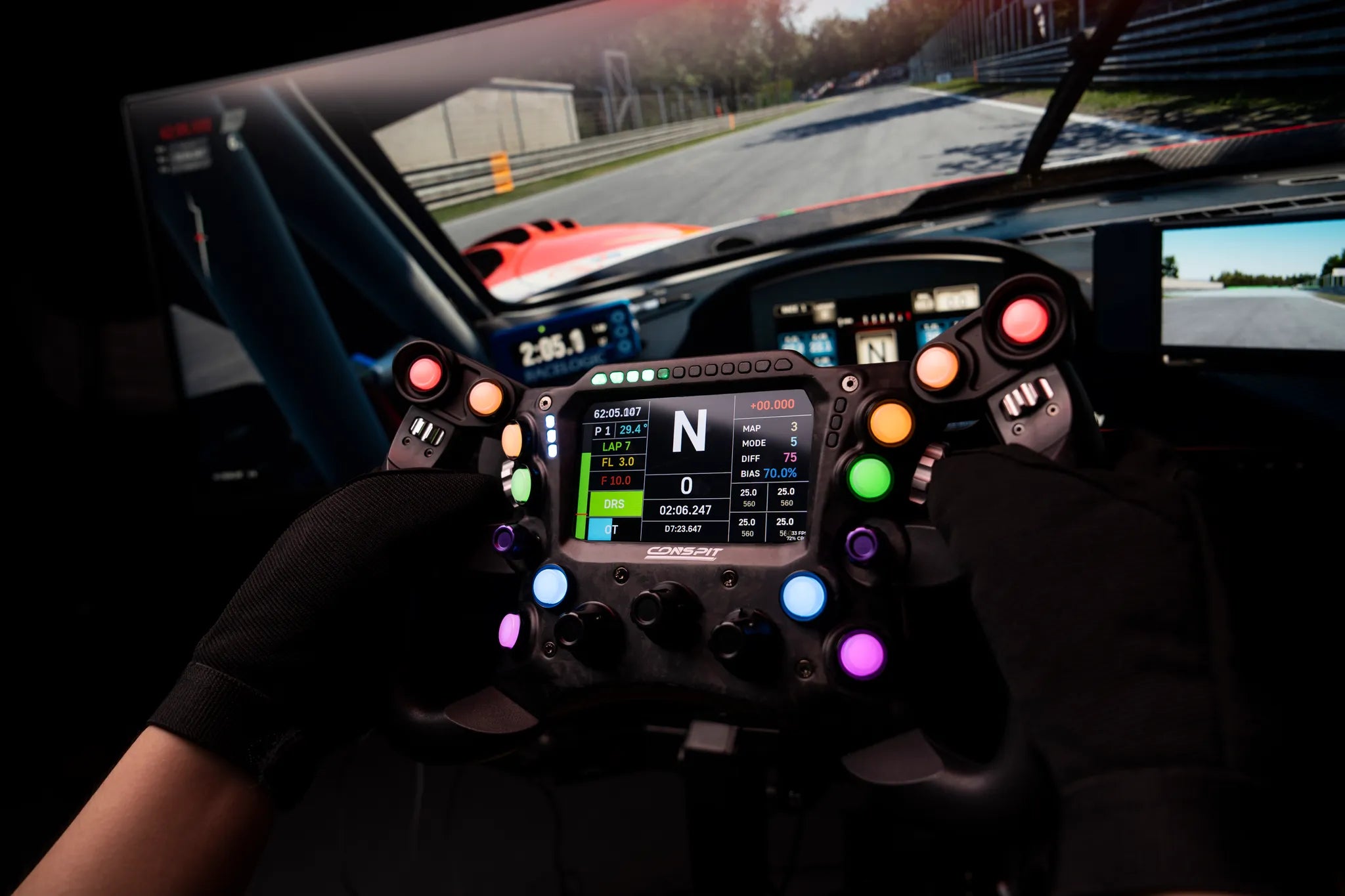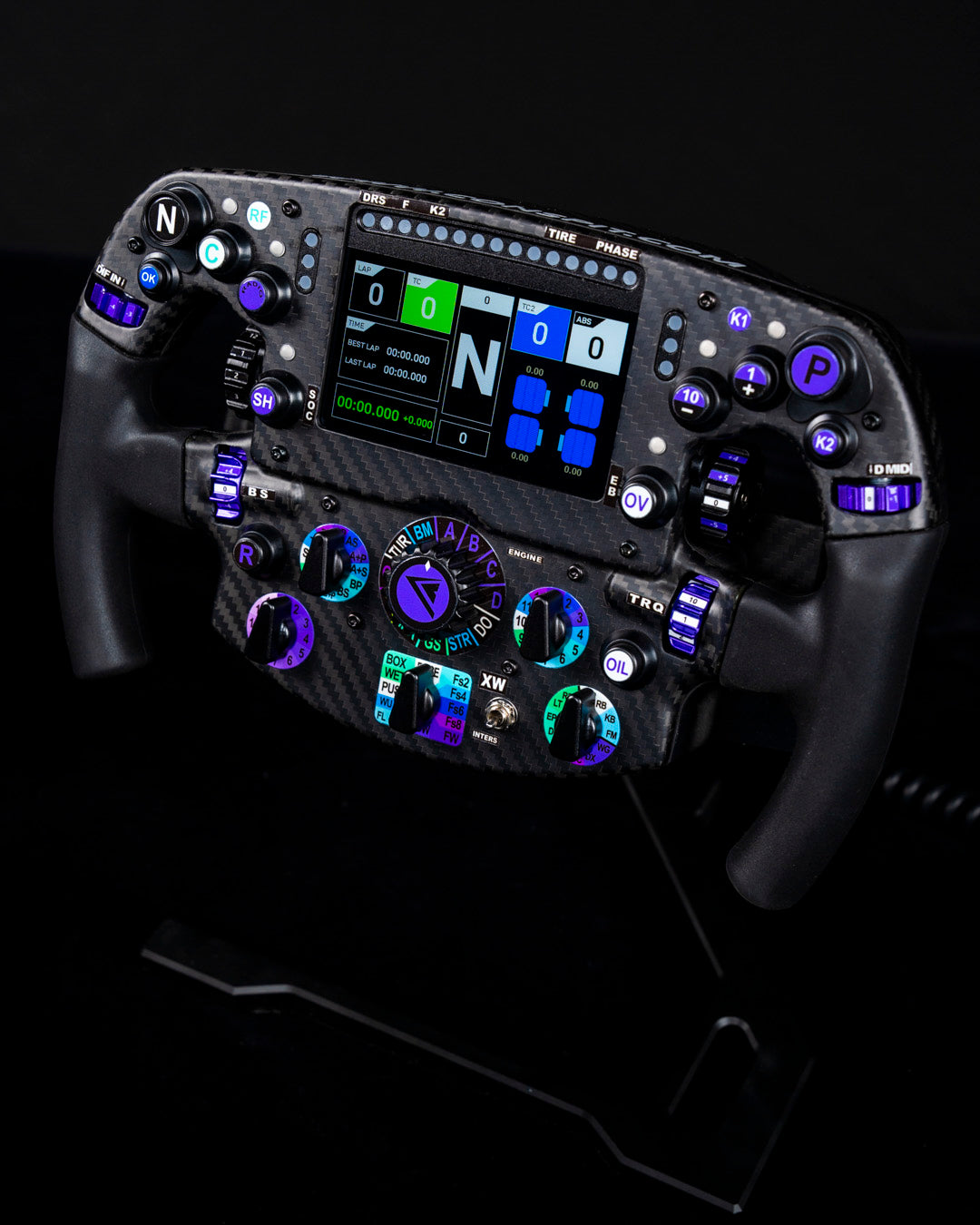

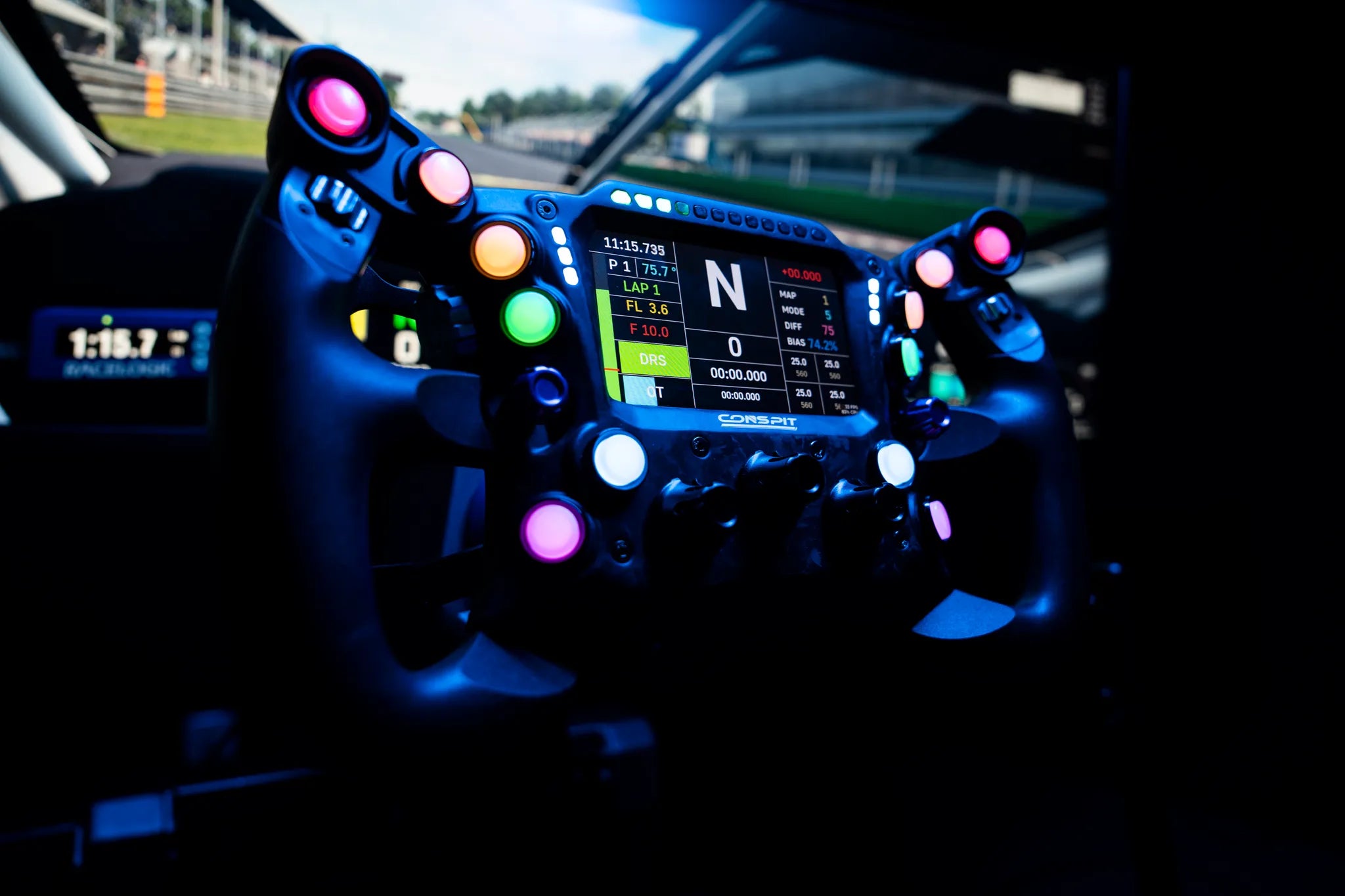
CONSPIT 290GP — détail du volant formula
Formula car steering wheels

Collection: Formula car steering wheels

Un volant Formula se reconnaît à son format rectangulaire compact, généralement compris entre 280 et 300 mm. Cette géométrie n’est pas qu’une question de style : elle répond directement à la manière dont on pilote une monoplace.

Sur une F1 ou un prototype, les mains ne quittent jamais la jante. Les angles de braquage restent faibles et les corrections se font par petits mouvements, ce qui rend inutile — et même gênante — la partie basse d’un volant rond. Le format Formula libère en contrepartie de la place pour les commandes : c’est sur ces volants que l’on trouve les plus fortes densités de boutons, d’encodeurs et de sélecteurs rotatifs, indispensables pour ajuster répartition de freinage, mapping moteur et différentiel en pleine course.

Le poids constitue le second critère de choix. Une jante légère change de direction plus vite et laisse mieux passer les micro-détails transmis par la base, tout en réduisant la fatigue des avant-bras sur une course longue. Les modèles en fibre de carbone descendent sous les 1,3 kg tout en conservant une rigidité supérieure à l’aluminium.

Vérifiez enfin l’entraxe de fixation — 50,8 mm ou 70 mm selon les modèles — et la compatibilité avec votre Quick Release avant de commander.

CONSPIT 290GP — volant formula pour simulateur de courseCONSPIT 290GP — volant formula, vue 2
encodeur
5 rotary encoders
charge
1.45 kg
290 mm
boutons
12 programmable buttons
2 paddles
Carbon Fiber
CNC Machined
connexion
Quick Release
garantie
Manufacturer Warranty
encodeur
5 rotary encoders
charge
1.45 kg
290 mm
boutons
12 programmable buttons
2 paddles
Carbon Fiber
CNC Machined
connexion
Quick Release
garantie
Manufacturer Warranty
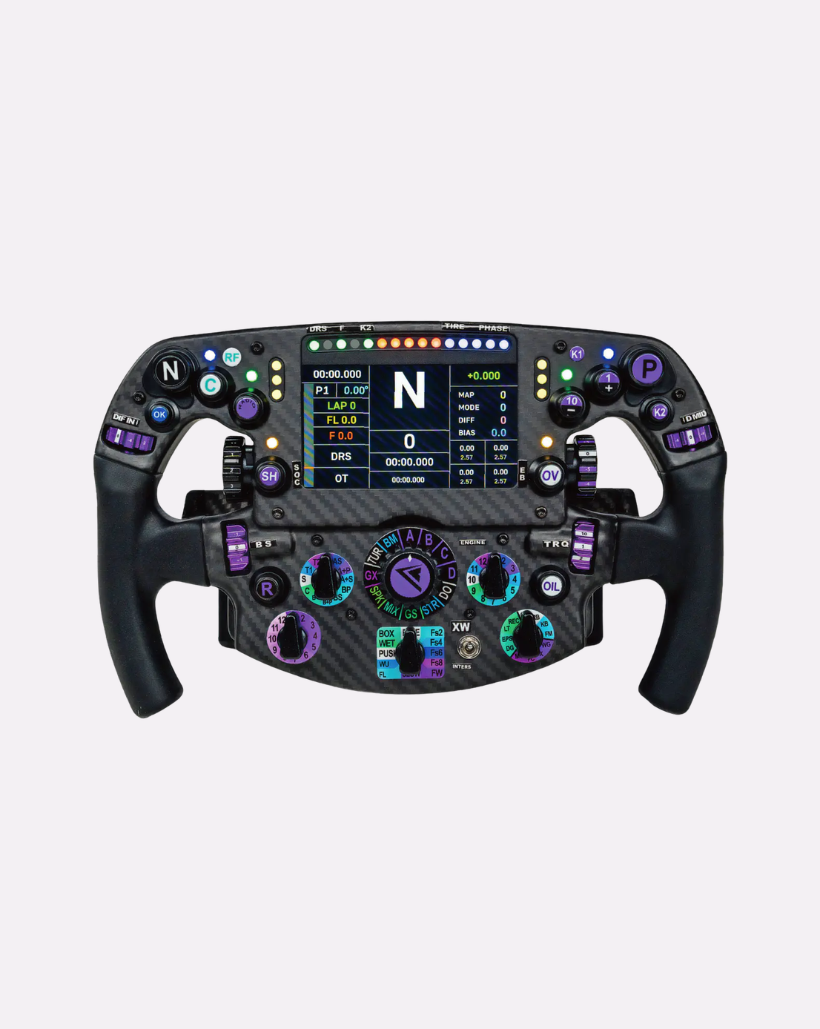
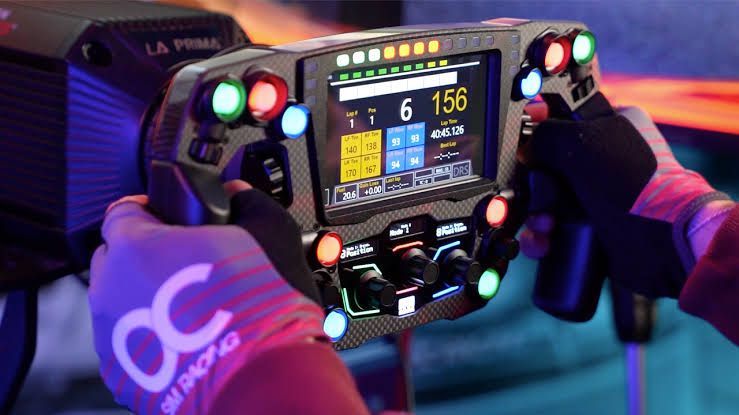
CONSPIT PW1 — volant formula pour simulateur de courseCONSPIT PW1 — volant formula, vue 2
SaleSold out
4,3 inches
PC Compatible
connexion
Quick Release
garantie
Manufacturer Warranty
4,3 inches
PC Compatible
connexion
Quick Release
garantie
Manufacturer Warranty
Vendor: CONSPIT
Regular price $2,519.00 CAD Sale price$2,393.00 CAD
REXING Mayaris 2 — volant formula, vue 2

Formula steering wheels
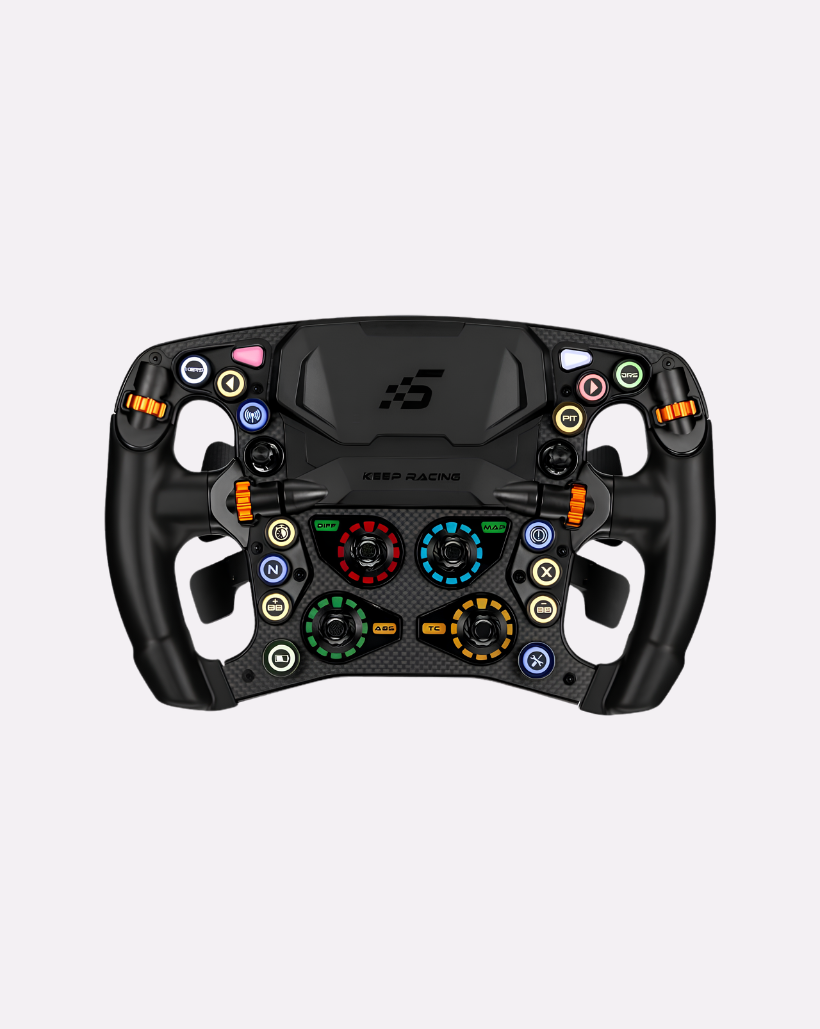
Compact format and a fixed hand position, for formula and prototype racing.

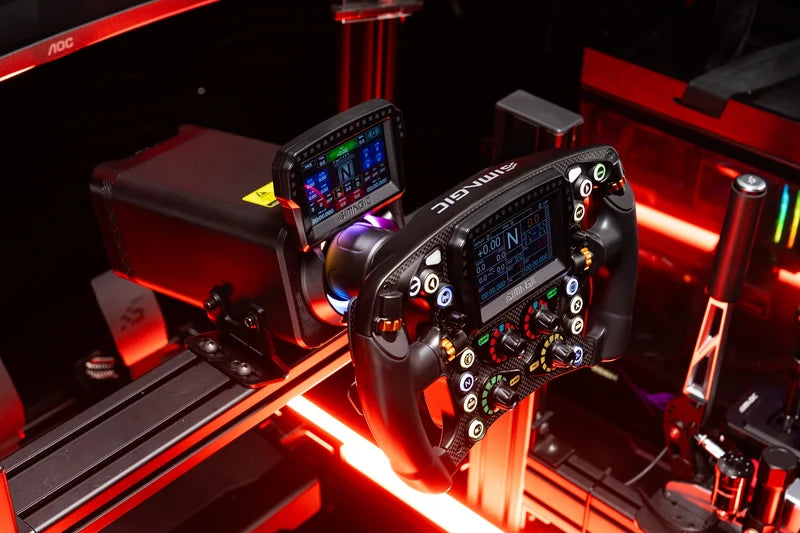
SIMAGIC Zeus Formula — volant formula pour simulateur de courseSIMAGIC Zeus Formula — volant formula, vue 2
280 mm
PC Compatible
SimHub Compatible
Carbon Fiber
CNC Machined
connexion
Quick Release
garantie
Manufacturer Warranty
280 mm
PC Compatible
SimHub Compatible
Carbon Fiber
CNC Machined
connexion
Quick Release
garantie
Manufacturer Warranty
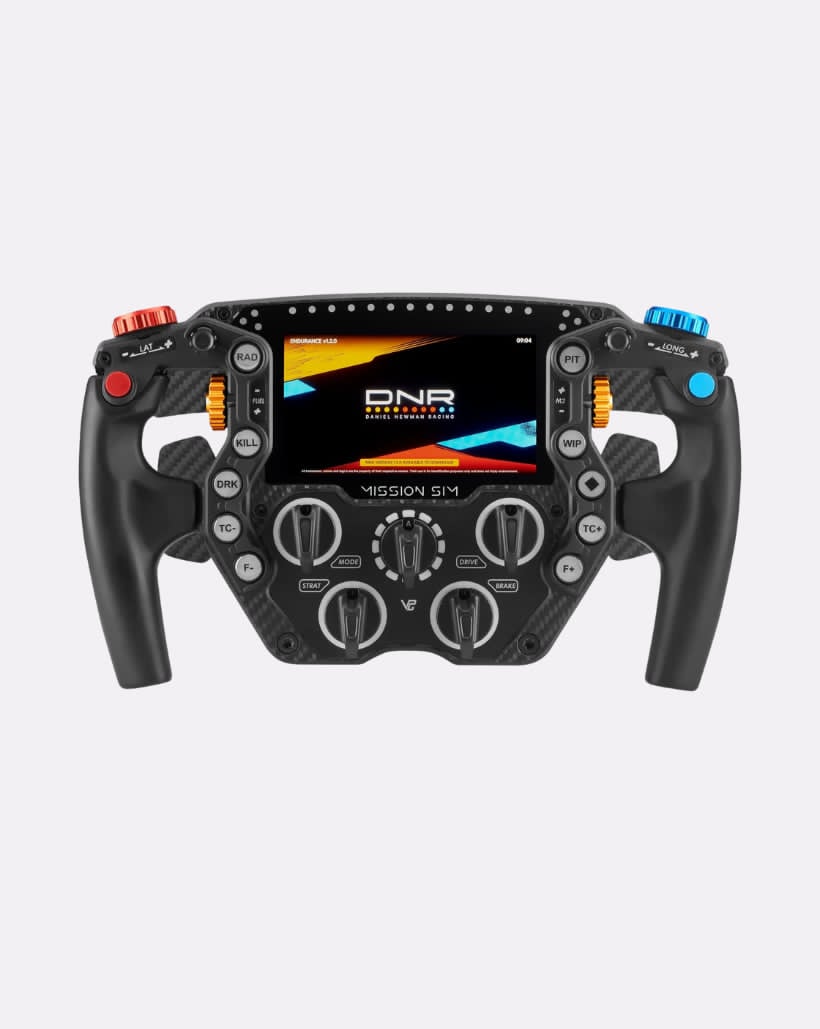
VPG Sim Mission Sim — volant sim racing gt/proto pour simulateur de courseVPG Sim Mission Sim — volant sim racing gt/proto, vue 2
5 inches
290 mm
boutons
12 programmable buttons
PC Compatible
SimHub Compatible
Carbon Fiber
connexion
Quick Release
garantie
Manufacturer Warranty
5 inches
290 mm
boutons
12 programmable buttons
PC Compatible
SimHub Compatible
Carbon Fiber
connexion
Quick Release
garantie
Manufacturer Warranty

Fast shipping

Get free shipping on orders over $200

Easy, hassle-free returns

Return your items up to 30 days after purchase*

100% secure checkout

All payments are processed securely

Service client exceptionnel

Our team of enthusiasts is available 24/7

Frequently asked questions

We have the answers.

It's possible, and many drivers use a single Formula wheel for everything. But for GT endurance, a GT wheel with a larger rim offers more comfort on long stints.

SimHub lets you fully customize the display: screen pages, telemetry data, shift-light LEDs and flags. The Rexing Mayaris 2 uses it natively.

Between 270 and 300 mm. Smaller means sharper steering, ideal for single-seaters where steering angles are small and quick.

8 Nm minimum to reproduce the firmness of a single-seater's steering. Competitive drivers aim for 12 to 18 Nm with a Simagic EVO or a Moza R12 V2.

It uses a standard quick release; check exact compatibility with your base or contact us to confirm before buying.

The Mayaris 2 offers excellent value for boutique-made construction; the Mission Sim, with its 60 controls, sits higher up the range for the most demanding competitive drivers.

Absolutely: it's even the preferred format for prototypes, where the rotary encoders' control density directly serves race management.

No, unlike spring-loaded mechanical paddles, magnetic technology has no physical contact to wear out: precision stays the same for years.

Buying Guide: Formula Wheels

The Formula wheel reproduces the tool used by single-seater and prototype drivers: an open profile with no top rim, a fixed 9:15 grip, and a control density that puts your entire race strategy at your fingertips. If you race F1, F3, F4, IndyCar or LMP, this is the format that matches what your hands see in the virtual cockpit.

Rexing Mayaris 2 and VPG Mission Sim

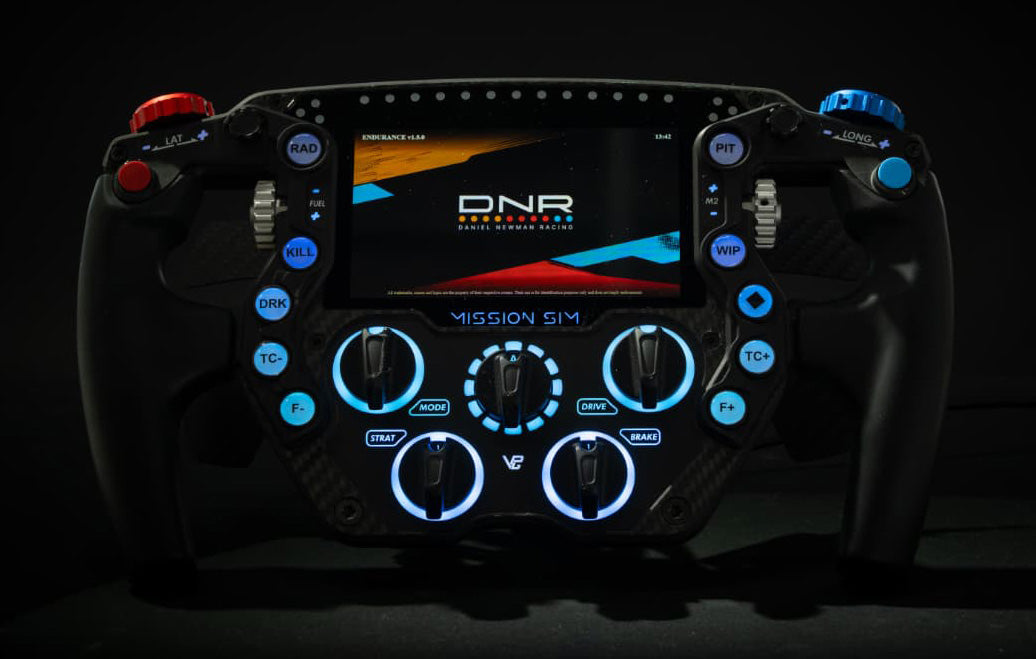
Two references stand out at PassionSim. The Rexing Mayaris 2 offers a carbon chassis, a 5-inch touchscreen, 10 RGB buttons, 3 OLED displays and magnetic paddles, all customizable through SimHub: a complete information platform worthy of a real racing wheel. The VPG Mission Sim, built for GT/Proto with its 290 mm rim, goes even further with 60 controls, 118 RGB LEDs and a professional-grade carbon-aluminum build.

What to check before you buy

Before buying, confirm three things: quick-release compatibility with your Direct Drive base, software support (SimHub opens up endless display customization possibilities), and the ergonomics of the rotary encoders if you race endurance with fuel and brake management. A Formula wheel pairs ideally with a base of 8 Nm and up (Conspit ARES, Simagic EVO, Moza R12 V2) to reproduce the firm steering of a single-seater.

Comparing the models and anticipating wear

Between the two references: the Mayaris 2 offers excellent equipment-to-price value in boutique manufacturing, while the Mission Sim, with its 60 controls, targets the most demanding competitive drivers. Both work perfectly for LMP endurance, where control density directly serves race management. And unlike spring-loaded mechanical paddles, magnetic paddles have no physical contact to wear out: precision stays identical for years.