

Last updated: October 2026. Prices checked in Canada on October 31, 2026, before tax.
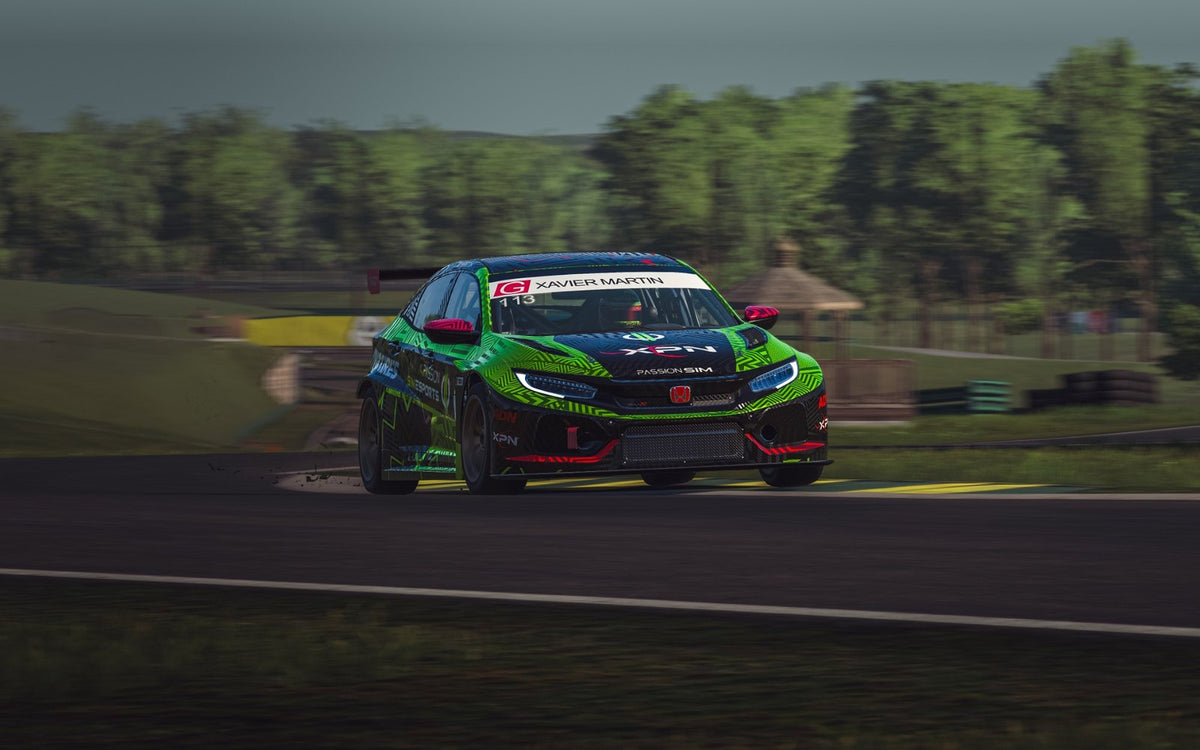
I have been using the Moza mBooster active pedal since April 2026, mostly racing TCR on iRacing in the Honda Civic Type R. Before that, I drove on a Simagic P2000, a high-end load cell pedal set. This review covers why I switched, what the active pedal changed in my braking, and the limits I found after six months of use.
THE SHORT ANSWER
- My rating: 8/10. For now, it is the best-value active pedal on the market.
- What changed for me: much better trail braking and more consistent braking from lap to lap.
- Easy installation, as long as your rig is rigid and everything is bolted down before you start.
- The downsides: a motor whine that surprises you at first, and a full setup that takes time if you want to get the most out of it.
- Who it is for: drivers who already race regularly and want to step up. Price: CA$1,099 on its own, CA$1,399 with the CRP2 throttle.

My context: TCR on iRacing
| Driver | PassionSim team member, sim racing since 2020, iRating above 3,000 in Sports Car |
| Main car | Honda Civic Type R TCR, iRacing |
| Championship | Alpha Touring Challenge (TCR league) |
| Using the mBooster | Since April 2026 |
| Previous pedals | Simagic P2000 (load cell) |
| Settings | Built-in Honda Civic Type R profile in MOZA Pit House |
In TCR, braking decides almost everything: the car is front-wheel drive, heavy at the front, and you win or lose time on corner entry, while you release the brake as you turn in. That makes it the right place to judge a brake pedal.
Why move from a P2000 to an active pedal
The P2000 is an excellent load cell pedal set. Like any passive pedal, though, it offers a fixed resistance: the pedal always behaves the same way, whatever the car is doing. Your brain learns a pressure, which is what makes a load cell more consistent than a position sensor (our pedal guide explains this in detail).
The usual reasoning when moving from a high-end load cell to an active pedal goes like this: you are no longer looking for more force or more precision, you are looking for more information. On a passive pedal, you guess wheel lock or ABS activation from the picture, the sound or the wheel. On an active pedal, you feel it directly under your foot, as in a real car.
That is what made me switch: I had reached a level where braking consistency mattered more than anything, and I wanted to take the next step as a driver.
What an active pedal adds
An active pedal is driven by a servo motor. Instead of a fixed resistance set by a spring or an elastomer, the motor changes the resistance and adds effects in real time, based on the game's telemetry. On the mBooster, you can adjust:
- ABS: the pedal vibrates when the system kicks in;
- wheel lock: you feel the threshold before you cross it;
- engine vibration and load effects;
- travel, angle and curves of the pedal, in MOZA Pit House.
Force is still read by a load cell (dual 200 kg load cell): you keep the muscle memory of pressure, and add feedback from the car on top.
Installation and settings
Installation and setup went smoothly. The one thing to check beforehand: that everything is solidly bolted to your rig. An active pedal that pushes back against your foot and vibrates puts the mount to the test; the slightest flex in the pedal plate or the profile is felt and blurs the effects. Our cockpit guide explains what to check for rigidity.
For settings, I use the built-in Honda Civic Type R profile in Pit House. If you mostly drive one car, it is the ideal starting point: the move from the P2000 was very easy, without spending hours hunting for the right values. Pit House runs on PC, so the mBooster is aimed at PC sim racing.
On track: trail braking and consistency
The clearest change for me is trail braking: gradually releasing the brake as you turn toward the apex, to keep weight on the front. My trail braking has improved noticeably, and my braking is more consistent overall. I see it in my results too.

This telemetry trace shows the difference at the first big braking zone at Virginia International Raceway. With the P2000 (in blue), the pedal stays at 100% for the whole first part of the braking zone, drops sharply to around 40%, holds that level, then releases almost all at once: stepped braking. With the mBooster (in red), the initial hit is the same, but I come off the maximum earlier, modulate the pressure around the threshold, then release it gradually all the way to the apex. That is what trail braking looks like. The same pattern shows, on a smaller scale, in the next braking zone.
Two caveats. This is one lap each, not an average. And I do not compare lap times: I bought the mBooster after the TCR update on iRacing, so the two laps were not driven with the same version of the car. The trace shows a change in braking technique, not a timed gain.
The reason is the information you get during the release. With a passive pedal, you release based on the memory of a pressure. With an active pedal, you feel the moment the front starts to lock or the ABS starts working, while you are turning. You adjust the pressure instead of guessing it, so each corner entry is closer to the last.
That is also what makes the pedal more forgiving: mistakes cost less. Braking a little too hard is felt right away, and you correct it before it turns into a lock-up or a wide exit. Overall, you get more feel for what the car is doing. In endurance racing, that is an advantage: over a long stint, consistency is worth more than one fast lap.
I had no fatigue or comfort issues. It does take a few sessions to adapt at first: your foot has to learn to read the new effects rather than fight them. For the same reason, a thin sole helps you feel them (see our guide to sim racing shoes).
The downsides
- Motor whine. When you first power it on, the servo noise is a bit surprising. You get used to it quickly, and with headphones you no longer hear it at all. Worth considering if you race without a headset in a shared room.
- The full setup. The built-in profile is enough to drive well, but using every option and effect in Pit House takes time. If you really want to get the most out of it, plan for setup sessions, car by car.
Who it is for, and who it is not for
| I recommend it if… | I do not recommend it if… |
|---|---|
| You race regularly and want to step up | You are just starting: a good load cell is a better first investment |
| You are working on trail braking and consistency | You race on console (Pit House runs on PC) |
| Your rig is rigid | Your pedals sit on a mount that flexes |
| You race with headphones | Motor noise would bother the people around you |
For a beginner, the logical order is still: a load cell pedal set and a stable rig first, then an active pedal. Our Simgrade vs Heusinkveld vs VRS comparison covers high-end load cell pedals.
Verdict and competition
My rating: 8/10. For now, the mBooster is the best-value active pedal. It made me more consistent and better at trail braking, which is exactly what I was after when I left the P2000.
The category is moving fast: Simagic is due to launch its own active pedal soon, and Simucube is preparing a more affordable version of its own. I will update this review once they are out.
See the Moza mBooster active pedal
CA$1,099 on its own, CA$1,399 with the CRP2 throttle, before tax. Available to order from PassionSim.
Moza mBooster All pedal sets Moza basesSpecifications
| Feature | Moza mBooster (manufacturer data) |
|---|---|
| Type | Servo-driven active brake pedal |
| Force reading | Dual 200 kg load cell |
| Angle sensor | 15-bit |
| Motor encoder | 21-bit (about 2,097,152 counts per revolution) |
| Effects | ABS, traction control, engine vibration, load effects |
| Settings | Travel, angle, curves, effects in MOZA Pit House (PC) |
| Build | CNC-machined aluminium and high-strength steel |
| Included (CRP2 pack) | mBooster pedal, CRP2 throttle, CRP2 plate and extended plate |
| Price in Canada | CA$1,099 on its own, CA$1,399 with CRP2 (before tax, Oct. 31, 2026) |
Frequently asked questions
Is the Moza mBooster worth it?
For a regular driver, yes: it is currently the best-value active pedal. I give it 8/10. For a beginner, a good load cell pedal set is still a better first purchase.
What does an active pedal change compared with a load cell?
A load cell reads pressure, but its resistance is fixed. An active pedal adds the car's effects in real time (ABS, lock-up, vibration): you feel what is happening under braking instead of guessing it.
Is the mBooster noisy?
The motor makes a whine that is surprising at first. You get used to it, and with headphones you no longer hear it.
Does the mBooster work on console?
Settings go through MOZA Pit House, on PC. The mBooster is therefore aimed at PC sim racing.
Do I need a specific rig?
You need a rigid rig and a solidly mounted pedal plate. Any flex is felt and blurs the active pedal's effects.
Review written by a PassionSim team member based on their own use of the mBooster since April 2026. The mBooster is sold by PassionSim. Photos of the pedal in their rig coming soon.