

Last updated: October 2026. Canadian price checked on October 16, 2026, before tax.
It is one of the questions we hear most often at the store: do you really need shoes for sim racing, or are socks just as good? The honest answer: it mostly depends on your pedals. With light pedals, socks are perfectly fine. With a load cell, hydraulic or pneumatic brake set up stiff, the sole becomes part of your gear, just like the wheel. This guide explains why, compares the options and helps you decide.
THE SHORT ANSWER
- Position-sensing pedals (entry level): socks or bare feet are fine, no rush.
- Load cell, hydraulic or pneumatic pedals: shoes with a thin, rigid sole are far more comfortable and make your braking more consistent.
- Street shoes and thick-soled sneakers are the worst choice: they filter the feel and catch the next pedal.
- What matters: a thin, rigid sole, a narrow profile, a flexible upper and low weight. You do not need to pay for certified racing boots.
- After switching, recalibrate your maximum brake force: you will push harder in shoes than in socks.

The short answer, by pedal type
| Your pedals | Brake force | Our advice |
|---|---|---|
| Position or Hall effect sensor (entry level) | Low, spring or elastomer | Socks or bare feet: perfect |
| Load cell, set soft | Moderate | Socks work, shoes are more comfortable in long sessions |
| Load cell, set stiff | High | Thin-soled shoes recommended |
| Hydraulic or pneumatic | High and progressive | Thin-soled shoes recommended |
Actual force depends mostly on your settings, not just the sensor.
If you are just starting out, shoes are not the first purchase: our beginner's guide and price guide show where the money goes first. Shoes come naturally once your pedals move up a level.
What the sole actually changes
Under braking, what you remember is a pressure, not a position. Our pedal guide covers this in detail: force is far easier to repeat lap after lap than a pedal angle. Anything between your foot and the pedal therefore affects that muscle memory.
A thick, soft sole, like a running shoe's, absorbs part of the effort and spreads it over time. You feel less clearly when the pedal firms up, and so where the lock-up threshold is. On the other hand, a sock on a stiff pedal lets all the feel through but concentrates pressure on a small area of your foot: after an hour of 40 or 50 kg stops, the ball of your foot feels it. Your foot can also slide on the pedal face.
A thin, rigid sole does both: it spreads pressure across the front of the foot without filtering the feel. That is exactly the principle behind real racing boots.
Socks, bare feet, street shoes or sim racing shoes
| Option | Strengths | Limits |
|---|---|---|
| Socks | Free, direct feel, easy to slide between pedals | Slip on smooth pedals, uncomfortable with a stiff brake |
| Bare feet | Maximum feel, good grip | Painful with a stiff brake, pedal edges under the ball of the foot |
| Street shoes, sneakers | Already in your closet | Thick sole filters the feel, too wide, dirt on the pedals |
| Karting or racing boots | Designed for driving, very precise | Expensive, certification is useless in a sim |
| Sim racing shoes | Thin rigid sole, light, kept for the rig only | One more purchase, worth it when your pedals justify it |
One detail people forget: shoes kept for the rig stay clean. No gravel or sand on the pedal plates, and grip that stays the same from one week to the next. In a Canadian winter, that is far from a detail.
Why your pedal type changes everything
On entry-level position-sensing pedals, the brake is held back by a soft spring or elastomer: it takes little force, and socks are more than enough. On load cell pedals, the brake measures force; most drivers set it to brake between 30 and 60 kg. At that level, the comfort gap between a sock and a rigid sole becomes obvious by the second half hour.
Hydraulic and pneumatic pedals add progressive resistance that you read in the very last millimetres of travel. That is where a thin sole makes the biggest difference. If you are weighing these technologies, compare the SRP GT-R and GT-S or read our Simgrade, Heusinkveld and VRS comparison.
The simple rule
If you push hard enough to feel the pedal in the ball of your foot after a session, it is time to switch to shoes.
What to look for in a shoe
| Criterion | Why |
|---|---|
| Thin sole | Keeps the pedal feel, especially in the last millimetres of braking |
| Rigid sole | Spreads pressure across the front of the foot, with no pressure point |
| Narrow profile | Avoids catching the next pedal, essential for heel-and-toe |
| Flexible upper | Supports the ankle without locking it: you modulate the throttle with the ball of your foot |
| Light weight | Nothing to weigh down the movement or tire the leg |
| Breathable material | Comfort over endurance sessions lasting several hours |
The heel matters too: a sole that is too rounded at the back rolls on the heel plate. If your pedals do not have one, a heel riser or a heel stop steadies the foot and makes the movement more repeatable.
Our sim racing shoes

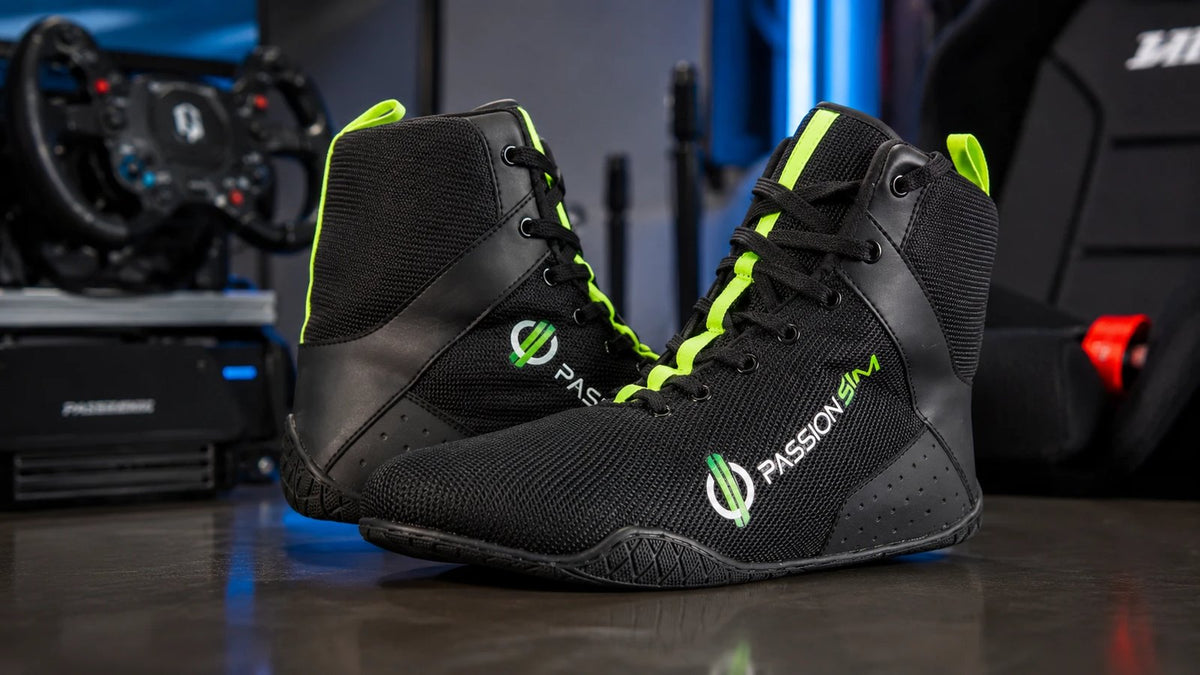
We developed our own PassionSim sim racing shoes to answer this question without paying for certified racing boots: a thin, rigid sole, a narrow profile, a light, breathable high-top upper, 600 g a pair. They come in sizes 8 to 13, at CA$60 before tax, exclusive to PassionSim. They are the ones we use on the simulators at our store.
They will not replace good pedals: on an entry-level set, keep your budget for the next upgrade. They really pay off with a stiff brake.
See PassionSim sim racing shoes
Sizes, availability and reviews on the product page.
Sim racing shoes All pedal setsSettings to redo after switching
Moving from socks to shoes, you will naturally push harder: the sole removes the discomfort that was holding you back. Three settings to redo:
- Maximum brake force: in your pedal software, recalibrate so that 100% brake matches your new maximum effort, otherwise you will lock the wheels.
- Seat position: a sole adds a few millimetres; check that your leg stays slightly bent at full braking.
- Pedal spacing: with a narrow profile, you can sometimes bring the throttle and brake closer for heel-and-toe.
Then run the test we recommend to everyone: ten laps in socks, ten laps in shoes, same track, same car. Compare how consistent your braking points are rather than your best lap.
Frequently asked questions
Do you need shoes for sim racing?
Not necessarily. With entry-level pedals, socks are enough. With a load cell, hydraulic or pneumatic brake set up stiff, thin-soled rigid shoes are far more comfortable and make your braking more consistent.
Is it better to sim race in socks or shoes?
In socks, the feel is direct but pressure concentrates on the ball of the foot and your foot can slide. In thin-soled shoes, pressure is spread without filtering the feel. The stiffer the brake, the bigger the advantage for shoes.
Can you sim race barefoot?
Yes, on light pedals. With a stiff brake, the pedal edges quickly become painful.
Are running shoes good enough?
They are the weakest option: the thick, cushioned sole filters brake feel, and their width makes them catch the next pedal.
Do you need certified racing boots?
No. Certification protects against fire in a real car; in a sim, only a thin rigid sole, a narrow profile and comfort matter.
Which size should I pick for PassionSim shoes?
They come in sizes 8 to 13. If in doubt, contact us or try them on at the store.
Written by the PassionSim team, a Canadian sim racing store. We sell, build and drive this gear every day — send us your questions or come try a simulator in store.