

Updated November 9, 2026. Canadian prices as of that date, before taxes.
On paper, the Conspit 300GT and the Simagic GT Neo look a lot alike. Two 300 mm GT wheels, each a little over a kilo, with magnetic shifters and two clutch paddles. Yet the 300GT costs $178 to $234 more, depending on promotions. Where does that difference go, and is it worth it for you?
The short answer comes down to two questions: do you want a screen on your wheel, and which base will you mount it on? If you drive on a Conspit base and like having your data in front of you, the 300GT earns its price. If you have a Simagic base, or your budget needs to go elsewhere in your setup, the GT Neo covers the essentials for much less.
In this article, you'll learn:
- What the two wheels have in common
- The screen and lighting, where the price difference goes
- The controls under your fingers
- Build and feel in the hands
- How your base shapes the choice
- Which one suits the way you drive
Shop the Conspit 300GT steering wheel
Shop the Simagic GT Neo steering wheel

Two GT wheels cut from the same cloth
Both wheels use a 300 mm diameter, the reference size for GT and endurance. They weigh almost the same: 1,150 g for the 300GT, without quick release or adapter, and 1,100 g for the GT Neo, without quick release. With 50 g between them, the rotating mass is practically identical, so neither one filters out more of the detail coming from the base.
The shift paddles are magnetic on both models, with Hall sensors, so they're silent and have no switch to wear out. Each adds two clutch paddles, handy for standing starts. The buttons have RGB backlighting, the lighting can be driven by SimHub, and both wheels are built for PC.
| Conspit 300GT | Simagic GT Neo | |
|---|---|---|
| Diameter and weight | 300 mm, 1,150 g | 300 mm, 1,100 g |
| Screen | 2.99-inch colour (800 x 268) | None |
| Lighting | 48 RGB LEDs, including 12 rev lights | 15 rev LEDs, RGB buttons |
| Controls | 8 buttons, 4 knobs, 3 twelve-position switches, 2 seven-way joysticks | 10 buttons, 4 encoders, 2 thumb encoders, 2 seven-way switches |
| Quick release | Wheel side sold separately, 50/70 mm adapter included | Simagic QR50 included |
| Price at PassionSim | $503 (regular $559), Champion $601 | $325 |
Weights without quick release. Prices as of November 9, 2026, before taxes.
Screen and lighting: where the price difference goes
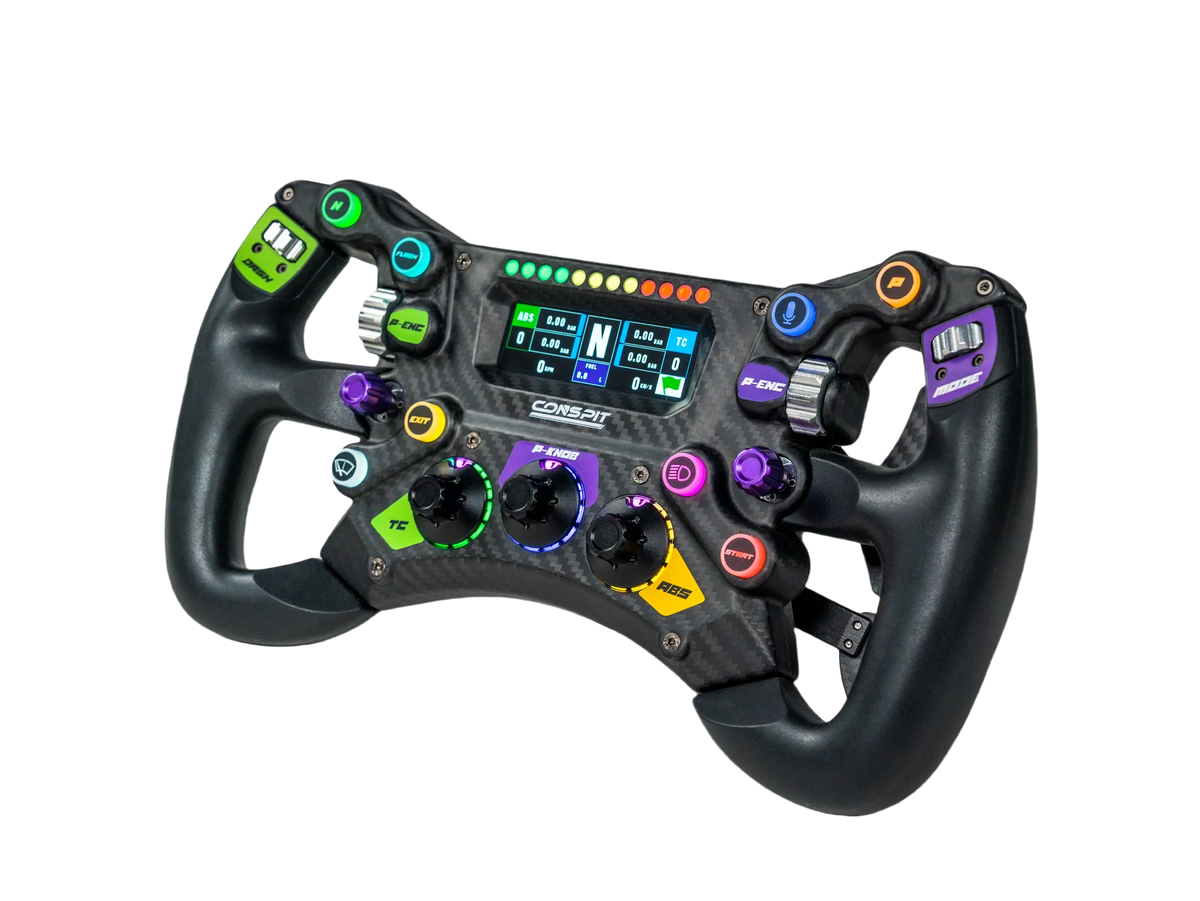
The 300GT has a 2.99-inch colour screen in the centre, at 800 x 268. Conspit offers seven telemetry pages, with more promised through updates. Around it sit 48 RGB LEDs, including 12 rev lights and 36 knob lights, which are very handy when you race in the dark. Everything is set up in Conspit Link 2.0.
The GT Neo has no screen. It keeps a 15-LED rev strip and RGB buttons, which is enough to shift at the right moment. For everything else, you read the data on the car's dashboard on screen, like plenty of drivers do.
Here's a simple test: during a race, do you look at your wheel's display? If you often change brake or traction settings on track, the 300GT's screen shows you the value without taking your eyes off the road for long. If you already have a separate telemetry screen, such as a Conspit CSD Nano on the base or a tablet running SimHub, the built-in screen loses much of its appeal, and the GT Neo becomes the logical pick.
The controls under your fingers
Both wheels offer a similar number of controls, laid out differently. The 300GT leans on switches: three twelve-position rotary switches, four knobs and two seven-way joysticks, on top of 8 buttons. Fixed-position switches are handy for engine maps or ABS modes, because you know where you are without looking.
The GT Neo spreads its 10 buttons around four encoders, two seven-way switches and two thumb encoders. Those thumb encoders are the wheel's signature feature: they let you adjust a setting without letting go of the grips, mid-straight. Simagic also includes stickers to label each button.
Build and feel in the hands
The 300GT pairs a carbon fibre faceplate with a machined aluminium body, which gives it great rigidity and a premium finish. It comes in two editions: Classic and Champion. The Champion, created with Yifei Ye, winner of the 2025 24 Hours of Le Mans, adds a gold-flake carbon faceplate and gold knobs. Screen, controls and weight are the same.
The GT Neo is moulded from an injection-moulded, carbon fibre reinforced composite. That's how Simagic can sell it at this price without making it heavier. Its grips were redesigned for a larger contact area, and its paddles adjust in length to fit your hands. When it comes to feel, nothing beats trying them, and it's a very personal call.

Your base makes part of the choice
On a Conspit ARES base
The 300GT is at home. With a Conspit quick release, power and data go through built-in contacts: no cable hangs behind the wheel, and everything is set up in one app. You do need the wheel-side half of the quick release, sold separately: the CDR ($69) or the CDP ($95) depending on your base's system. The GT Neo can be mounted on an ARES too, but its signal will run through a cable to the PC. Send us your base model to find out exactly which parts you need, or read our Conspit quick release guide, which covers each part.
On a Simagic base
It's the other way around. The GT Neo comes with its Simagic QR50 quick release and works out of the box on Simagic bases. The 300GT fits too, using the included 50/70 mm adapter and Simagic's wheel-side quick release, and then connects to the PC over USB. The price gap grows accordingly.
On another brand's base
Both wheels then need your base's quick release and a cable to the PC. For the GT Neo, that's the MagLink Pro ($63), a magnetic cable Simagic designed for third-party bases that also unlocks full SimHub support. For the 300GT, a USB cable does the job. Either way, you're building a PC setup: neither wheel works on PS5 or Xbox, as our compatibility guide explains.
Which one suits the way you drive
Pick the 300GT if you're building a Conspit setup, if you want your data on the wheel without an external screen, or if you often race endurance at night, where its 48 LEDs really earn their keep. The carbon and aluminium finish matters too if the wheel is the part you see and touch most. Our full 300GT review covers each of these points.
Pick the GT Neo if you already own a Simagic base, if you use a separate telemetry screen, or if the price difference is better spent elsewhere. With $180 to $235 between them, that's a good part of a pedal set or a monitor stand, and that's often where the tenths are found.
If you're also weighing a higher-end wheel, the Conspit MAX01 adds a 4-inch screen, and Simagic's Zeus range offers a detachable screen shared between several wheels; our Zeus ecosystem guide explains how it all fits together.
In the end, these two wheels don't target the same budget, but they meet the same need: a light, well-equipped GT wheel for long sessions. Start with your base, then ask yourself whether the screen will really change the way you drive. If you'd like a second opinion on your setup, write to us or drop by our store.
Shop the Conspit 300GT steering wheel
Shop the Simagic GT Neo steering wheel
Shop all Conspit steering wheels
Shop all Simagic steering wheels
FAQ
Do the Conspit 300GT and Simagic GT Neo work on PS5 or Xbox?
No. Both are Windows PC wheels. The 300GT is set up in Conspit Link 2.0 and the GT Neo in Simagic's software, and both can have their lighting driven by SimHub.
Is the quick release included?
The GT Neo comes with the Simagic QR50 quick release. The 300GT ships with a 50/70 mm adapter, but the wheel-side quick release is chosen separately: CDR or CDP for a Conspit base, or the one from your base's brand.
What's the difference between the 300GT Classic and the 300GT Champion?
Only the looks. The Champion edition, created with Yifei Ye, adds a gold-flake carbon faceplate and gold knobs. The screen, LEDs, controls and weight are identical.