

Last updated: September 2026.
Getting into sim racing is not about buying a wheel. It is about assembling four parts that have to work together: a wheelbase that tells you what the car is doing, a pedal set that translates your intentions, a structure that does not move, and a picture that gives you reference points. Spread a budget badly across those four and you get a frustrating simulator. Spread the same budget well and you get one that makes you faster. This guide covers how to split it, what to buy first, and what to avoid.
THE SHORT ANSWER
- The pedal set is what wins you lap time. It is the last place to cut corners.
- A base between 5 and 10 Nm is plenty to learn on and will stay relevant for years.
- A rigid structure beats a powerful base on a flexing desk: without rigidity, force feedback is lost in deflection.
- Think in three envelopes — entry, all-round and demanding. In all three, the split matters more than the amount.
- On console, compatibility is a licensing question: very few direct drive bases work on PS5 or Xbox.
What sim racing actually is
Sim racing is motorsport simulated with a serious physics model: tyres, weight transfer, aerodynamics, wear, temperature. What separates it from an arcade racer is not the graphics — it is what the car does when you go past the limit. In a simulator, braking too late does not forgive: the wheel locks, the front washes wide, and you lose a second. That is exactly why the hardware matters.
A sim racing wheel is not a bigger gamepad. It is a measuring instrument in both directions: it sends you what the physics engine calculates, and it sends the game the precision of your inputs. The cleaner that chain, the more you can drive by feel instead of by memory.
The good news for a beginner
You do not need high-end hardware to improve quickly. You need coherent hardware. A modest but balanced setup will teach you more than a powerful base badly installed.
The four building blocks of a setup

1. The base and the wheel
The base holds the motor that generates force feedback; the wheel is the rim you hold, attached through a quick release. On modern hardware this means direct drive: the wheel sits straight on the motor shaft, with no belt or gears in between, so nothing is lost between the physics engine and your hands. Power is quoted in newton-metres. We cover that in detail in how many Nm you actually need.
2. The pedals
The most underrated purchase and the one that pays back most. An entry-level pedal set measures the position of the pedal; a load cell set measures the force you apply. Moving from one to the other changes how you brake: you modulate with your foot, like in a real car, instead of memorising a distance. See load cell, hydraulic or pneumatic.
3. The structure
Rig and seat. Their job is thankless but decisive: stopping everything from moving. Every millimetre of flex under your feet or your hands is information you never receive. See which sim racing rig to choose.
4. The picture
One screen, three screens, an ultrawide or a VR headset. The most personal block and, contrary to popular belief, the least urgent: one well-placed screen with a correct field of view beats a badly calibrated triple. Monitor mounts can be added later on the same structure.
What to buy first
Many beginners buy in exactly the wrong order. They put almost everything into the base, then discover the pedals in the bundle are plastic and the whole thing slides on the desk. Here is the order we recommend.
| Order | Block | Why it sits here |
|---|---|---|
| 1 | Structure | It conditions everything else and never goes out of date. A rig bought today will hold the base you buy in three years. |
| 2 | Pedals | Braking is where the tenths are. It is also the part you keep longest. |
| 3 | Base | 5 to 10 Nm is enough to learn. More power adds nothing if the structure and pedals cannot keep up. |
| 4 | Wheel | A round rim covers GT, track and road driving. Formula rims come later, once you know what you race. |
| 5 | Display and extras | Screens, shifter, handbrake, dashboard. Comfort and specialisation, not foundations. |
This order assumes a tight budget. With a comfortable one you buy everything at once — but the split stays the same.
Three setups, by budget
Rather than quoting prices that move, here is the split that works. The percentages are the point: apply them to whatever envelope you have.

Tier 1 — entry
Goal: drive properly without overspending, on gear you will not throw away. Usually a complete bundle with base, wheel and pedals — the PXN VD6 Bundle or the Cammus C5 + CS5 let you start on real direct drive rather than a belt base. Add a folding wheel stand if space is tight.
Tier 2 — all-round
Where most enthusiasts settle for good. An 8 to 12 Nm base — Conspit ARES APEX 8 Nm, Simagic EVO 12 Nm or Moza R12 V2 — a load cell pedal set such as the Simagic P700, and an aluminium profile rig that will never move again.
Tier 3 — demanding
Now you are chasing detail: an 18 to 28 Nm base, hydraulic or pneumatic pedals (Conspit CPP.LITE, Simagic P2000, SRP GT-S and GT-R), an 80 or 120 mm profile rig, a rigid bucket seat, and often a handbrake or shifter depending on your discipline.
Browse complete bundles
Bundles pair base, wheel and pedals in a configuration that already makes sense together — the simplest way to start without a mismatch.
Bundles and packs Direct drive bases PedalsSix expensive beginner mistakes
1. Putting 70 % of the budget into the base
A 12 Nm base bolted to a particleboard desk, with spring pedals, gives you less than a 6 Nm base on a rigid rig with load cell pedals. Power is useless if it disappears into flex and you cannot modulate the brake.
2. Assuming more Nm means better feel
Peak torque tells you how strong a base can be, not how precise it is. Encoder resolution, processing frequency and rotor inertia matter at least as much. Plenty of fast drivers deliberately run at 40 to 50 % of available torque.
3. Neglecting the mount
A base that twists half a degree under load gives blurry force feedback. Always check that the mount is rated for your torque: a table clamp is fine for small bases, not for 12 Nm.
4. Buying a formula rim to drive GT cars
A formula rim does not turn past a quarter turn. Perfect in open-wheel, genuinely awkward in GT3, rally or road driving. Start with a round rim or a GT rim.
5. Forgetting the console question
The vast majority of direct drive bases are PC only. PlayStation and Xbox need specifically licensed hardware. Read PS5, Xbox or PC compatibility before ordering.
6. Running force feedback at maximum
Too much gain clips the small signals — the exact ones telling you the front is starting to slide. Set the gain so strong effects never saturate, then bring the detail up. A base well set at 60 % tells you more than a clipped one at 100 %.
Which titles to start with
| What you want | What to look for | Why |
|---|---|---|
| To learn properly, alone | A simulator with a detailed tyre model and laser-scanned tracks | Rich force feedback, reliable reference points, and progress that transfers elsewhere. |
| To race others in a championship | A platform with ratings, licences and scheduled races | Consistency matters more than a fast lap — that is where you learn traffic and race craft. |
| To drive for fun, across many cars | A broad, modern, well-optimised catalogue | Less demanding on precision, more generous on variety — ideal for finding what you enjoy. |
Whatever the title, take the time to calibrate pedals and steering angle in game: a bad software setting cancels out good hardware.
A PC that keeps up
Sim racing mostly needs stable frame delivery, not record numbers. A steady rate with no micro-stutter beats a high peak. If your machine is struggling, our PC optimisation service handles system, driver and in-game settings.
Try before you buy

Reading spec sheets is no substitute for ten minutes in a seat. The difference between a load cell and a spring pedal set is obvious within three braking zones; the difference between 8 and 20 Nm is immediate. It is also the best way to discover you need less power than you thought.
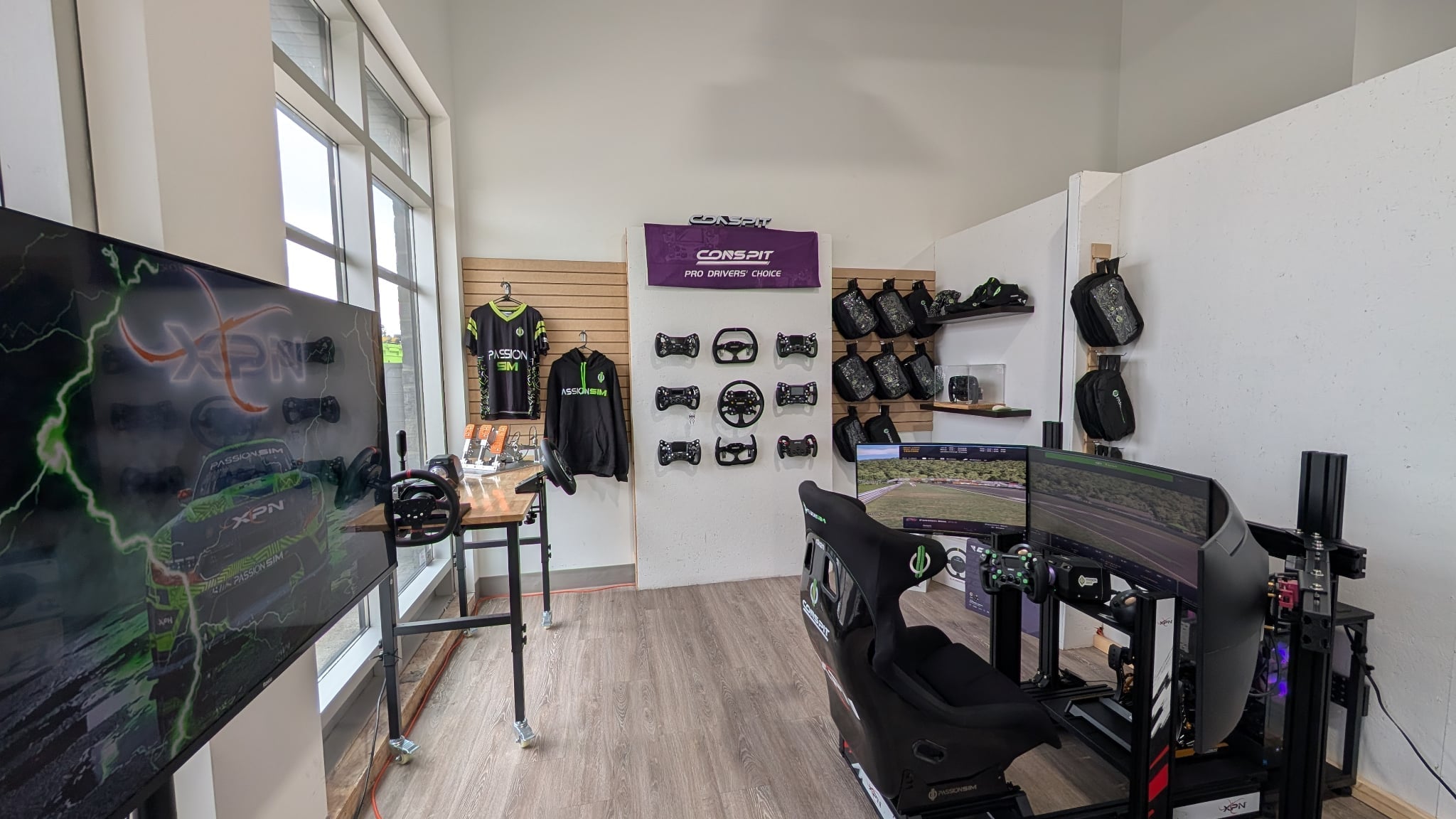
At PassionSim you can book an in-store driving session on a complete simulator. We also offer simulator rental for events, at-home installation of a complete setup, and sim racing coaching if performance is the goal.
Ready to build your first setup?
Tell us your budget, your platform and the space you have. We put together a coherent configuration rather than a shopping list.
All sim racing gear Contact usFrequently asked questions
Do you need a powerful PC for sim racing?
Less than people think. What matters is stable frame delivery, not peak numbers. A recent mid-range machine runs most simulators comfortably on a single screen. Triple screens and VR are what demand significantly more graphics power.
How much does a beginner sim racing setup cost?
There is no single price, but three tiers: an entry bundle with a small direct drive base, an all-round setup with an 8 to 12 Nm base and load cell pedals, and a demanding setup with hydraulic pedals and an aluminium profile rig. In all three, keep at least a quarter of the budget for the pedals.
Is a bundle better than buying piece by piece?
A bundle guarantees the parts are sized for each other and connect without adapters, which makes it the safest first purchase. Buying separately becomes interesting once you know what you want to prioritise — for example excellent pedals with a modest base.
Does sim racing really help with real driving?
For reference points, braking and learning circuits, yes — which is why professional drivers train on simulators. What a simulator cannot transmit is the load on your body. Good pedals and a rigid rig close much of that gap.
Can you sim race on PS5 or Xbox?
Yes, but the choice is narrow: a wheel must be licensed by the console maker to be recognised. On Xbox, the Moza R3 bundle with its licensed ESX rim works; on PlayStation 5, the Thrustmaster T598 is compatible. Most other direct drive bases are PC only.
How much space do you need at home?
A folding wheel stand fits in under a square metre and stores away. An aluminium profile rig with a seat occupies roughly 1.3 m by 0.7 m permanently, plus room to slide the seat back. That is the real trade-off: rigidity costs space.
Written by the PassionSim team, a Canadian sim racing store. We sell, build and drive this gear every day — send us your questions or come try a simulator in store.