

Last updated: September 2026.
The rig is the least exciting part of a simulator and the one that governs everything else. You do not replace it every year, it does not go out of date, and it decides how far you can go in power. Choosing between a folding wheel stand, a tubular rig and an aluminium profile chassis comes down to arbitrating two things that pull against each other: rigidity, and the floor space you are willing to give up permanently.
THE SHORT ANSWER
- Rigidity is not a luxury: every millimetre of flex is force feedback information that never reaches you.
- Up to 6 Nm, a desk mount can do. Past 12 Nm, aluminium profile becomes necessary.
- A wheel stand folds and stores away — the right answer when the room has another job.
- Aluminium profile is the only truly expandable format: seat, monitor mounts, handbrake and PC tray all bolt on.
- The seat is part of the rig: a rigid bucket transmits vibration, a soft chair absorbs it.
Why rigidity changes what you feel
A direct drive base applies torque to the wheel shaft. That torque needs something to push against: if the structure does not provide it, the structure deforms. Part of the energy then goes into flexing the support instead of reaching your hands. The symptom is recognisable — force feedback that feels soft, late, and stripped of fine detail, even with a powerful base.
Same at the pedals. Braking at 50 kg on a plate that slides back two millimetres destroys the reference: the same pressure no longer gives the same value twice. A good load cell pedal set that is badly mounted loses half its value.
The sizing rule
Choose the structure for the base you expect in two years, not the one you are buying today. It is the part you keep longest, and the one whose replacement costs the most in disassembly time.
The four families of support

1. Desk mount
A clamp fixes the base to a table top, with the pedals on the floor. It is the entry point: cheap, no extra footprint, and it comes off in thirty seconds. The MOZA table clamp is built for this. Two real limits: solidity depends entirely on your table, and the pedals will slide on the floor. Stay under 6 Nm and use a mat.
2. Wheel stand
A free-standing frame holding base and pedals, without a seat. It sits in front of an armchair or a sofa, then folds and stores against a wall. The PXN Z9 is a good example. It is the best compromise when the simulator shares a room with something else. Rigidity is far above a table clamp but below a full rig, especially at the pedals.
3. Tubular rig
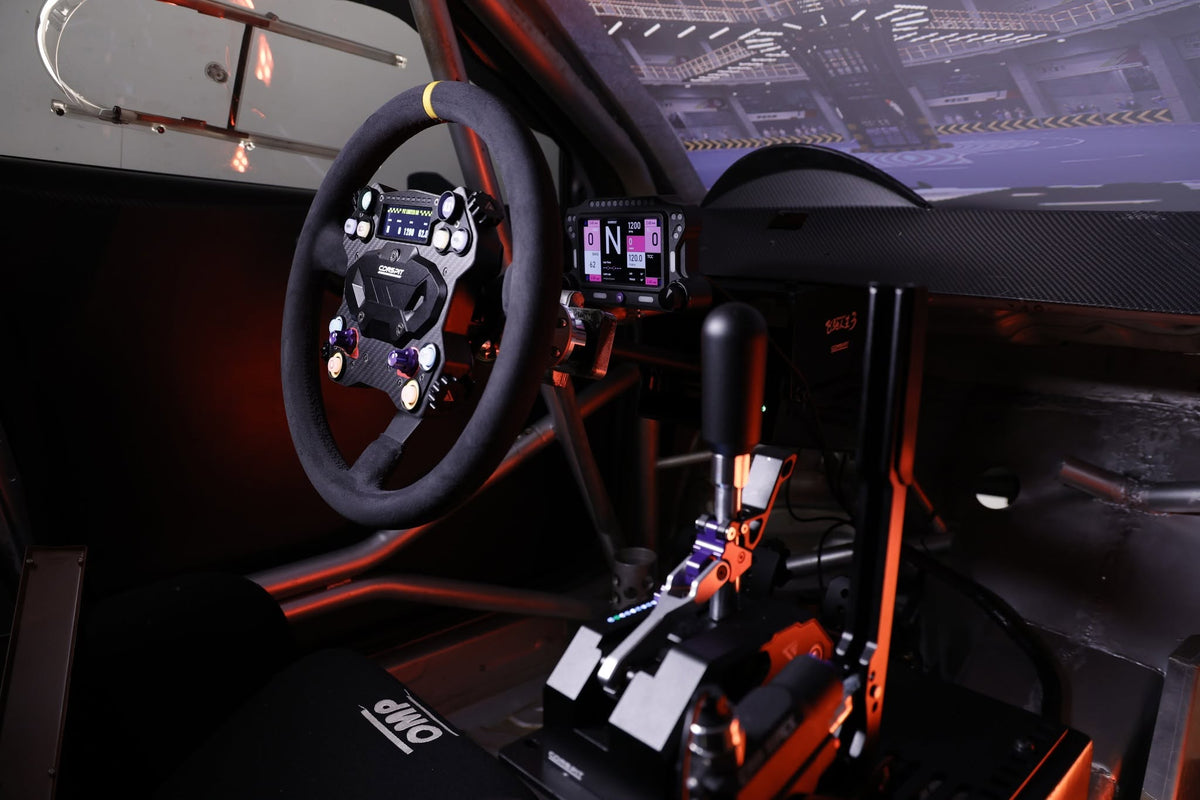
A welded or bolted steel frame with an integrated seat. It arrives nearly assembled, goes up in about an hour and offers serious rigidity for a measured footprint. The Conspit FP-Lite formula chassis, in carbon steel and around 30 kg, is a good example: a reclined single-seater position, ergonomic adjustment and a range of dedicated accessories — monitor mount, headrest, keyboard tray, shifter and handbrake plates.
Its limit is that of any closed frame: it is designed around one geometry. You adjust it; you do not reconfigure it.
4. Aluminium profile
Extruded slotted profiles assembled with brackets and T-nuts. It is the rigidity benchmark and, above all, the only genuinely expandable format: anything that bolts into a slot can be added, moved or removed. The 6SIGMA 6S-80 V2 (series 40 profile, around 30 kg, flex-free frame rated for bases up to 15 Nm) and the 6S-120 V2 (120 mm profiles) cover both levels.
The real argument is not rigidity alone: a profile rig follows your whole progression. You add a triple monitor mount, a PC holder, a keyboard tray, without ever replacing the base of the build.
Comparison and torque supported
| Family | Rigidity | Torque supported | Stores away? | Expandable? |
|---|---|---|---|---|
| Desk mount | Low, depends on the table | Up to about 6 Nm | Yes, in minutes | No |
| Wheel stand | Medium | About 8 to 10 Nm | Yes, folds | Limited |
| Tubular rig | Good | Up to about 15 Nm | No | Brand accessories |
| 40 mm aluminium profile | Very good | Up to about 15 Nm | No | Yes, fully |
| 80 to 120 mm aluminium profile | Excellent | 18 Nm and beyond | No | Yes, fully |
These figures are indicative: how the base is mounted matters as much as the profile size. A base bolted underneath and on the sides holds far better than one bolted underneath only.
Browse rigs and stands
Aluminium profile chassis, formula rigs, wheel stands and monitor mounts.
Rigs 6Sigma Seats Monitor mounts40, 80 or 120 mm: reading an aluminium profile
The number is the profile section. The larger it is, the more the beam resists torsion — and the heavier and bulkier the whole thing becomes.
- Series 40 (40 × 40 mm). The domestic sim racing standard. Rigidity is ample up to around fifteen newton-metres, at reasonable weight and cost. This is the 6S-80 V2 format.
- 80 mm. A wider main beam, often used for the crossmember carrying base and pedals. It stiffens exactly where loads are highest.
- 120 mm. A massive structure intended for the most powerful bases and for motion builds. This is the 6S-120 V2 format — unnecessary below 18 Nm, essential above it if you want absolute rigidity.
What to check before ordering
Your base's mounting points (Conspit ARES bases offer M6 × 4 underneath and M8 × 4 on the sides), the pedal plate and its distance and angle adjustment, seat compatibility, and whether a dedicated base mount exists — Conspit offers an ARES mount for aluminium profile.
The seat as a component in its own right
It is often left out of the budget, yet it changes two things. The obvious one: comfort over long sessions. The less obvious one: vibration transmission. A rigid bucket lets you feel kerbs and haptic effects; a padded office chair absorbs them.
Three criteria matter: shell rigidity, lateral support (a bucket that holds you lets you drive with your hands instead of bracing on the wheel), and mounting compatibility with your rig — standard rails or side mounts. The 6SIGMA RS adjustable and the PassionSim GT PRO cover common needs.
Screens: single, triple, ultrawide or VR

The rule is simple: peripheral vision is what counts, because it gives you speed and placement.
| Configuration | What it gives | What it needs |
|---|---|---|
| Single screen | Simple, affordable, no complex calibration. Enough to learn on. | A stable monitor mount and a correctly set field of view in game. |
| Ultrawide | More periphery without the triple-screen headache. | A solid mount; screens up to 49 inches fit on a single aluminium mount. |
| Triple screen | The best sense of lateral distance, decisive in traffic. | A rigid, angle-adjustable mount and a graphics card that keeps up. |
| VR | The strongest immersion and depth perception. | Plenty of graphics power, and a very rigid structure — with no fixed visual reference, any flex is felt. |
One detail that matters: mount the screens on the rig, not on a separate desk. If the seat moves and the screen does not, perception degrades. Aluminium monitor mounts, single or triple, are made to be part of the structure.
The space you actually need
Published dimensions describe the rig, not the installation. Plan for:
- Rig length — around 1.3 m for a 6S-80 V2, up to 1.85 m for an FP-Lite formula chassis in the reclined position.
- Seat travel: 20 to 40 cm more to get in and out.
- Screen depth and its mount, often 30 to 40 cm in front of the rig.
- Rear access for cables and power supplies.
In practice, allow roughly 2 m by 1 m of usable footprint for a comfortable permanent installation. If you do not have it, a folding wheel stand remains the right answer — better to drive on a moderate structure than not to drive at all.
Have it built for you
We assemble, wire and calibrate complete cockpits. It is often where the most is gained: a badly tightened rig cancels out its own qualities.
Simulator installation Browse rigsFrequently asked questions
Do you really need a cockpit for sim racing?
Not to begin with: a desk mount lets you drive with a small base. But as soon as you go past 6 to 8 Nm, or install load cell pedals, the structure becomes the limiting factor. It governs braking precision and force feedback detail.
What is the difference between a tubular rig and aluminium profile?
A tubular rig is a steel frame designed around a given geometry: it adjusts but does not reconfigure. Aluminium profile is modular — anything that bolts into a slot can be added or moved. Tubular is usually faster to assemble, profile is more expandable.
Does a cockpit fold away for storage?
A full rig does not: it is designed to stay in place. If the space is shared, look at a folding wheel stand, which handles bases up to roughly 8 to 10 Nm and stores against a wall.
Which profile for a 12 Nm base?
A well-assembled series 40 profile is enough. The 6SIGMA 6S-80 V2 is rated for bases up to 15 Nm. Past 18 Nm, a heavier 80 or 120 mm profile becomes relevant, especially to eliminate all torsion.
Can you use an office chair on a cockpit?
Technically sometimes, but it is a poor trade: a soft chair absorbs vibration and gives no lateral support, which makes you brace against the wheel. A rigid bucket improves both feel and precision.
How much room does a full cockpit need?
About 2 m by 1 m of usable footprint: rig length, seat travel to get in and out, monitor mount depth, and rear access for cables. A formula chassis in the reclined position needs more length.
Written by the PassionSim team, a Canadian sim racing store. We sell, build and drive this gear every day — send us your questions or come try a simulator in store.