

Last updated: September 2026.
If you could upgrade only one part of your simulator, it should be the pedals. Not the rim, not the base: the pedals. They decide whether you brake by feel or by memory, and braking is where most of the lap time lives. This guide covers the four sensing technologies, how to read the kilograms and bars on a spec sheet, and how to choose for the way you drive.
THE SHORT ANSWER
- A Hall effect pedal measures position; a load cell pedal measures force. That is the single most rewarding upgrade in sim racing.
- A hydraulic set adds a progressive pressure build-up very close to a real car. A pneumatic set cushions the end of travel and tires you less on long stints.
- The kg rating (sensor capacity) and bar figure (circuit pressure) do not describe quality: repeatability and adjustment matter more.
- An excellent pedal set that is badly mounted is wasted: base plate rigidity is part of the product.
- Two or three pedals: a clutch only helps if you drive manual gearboxes or practise standing starts.
Why pedals are the best-value upgrade
In a real car you do not look at your foot. You press until you feel the right resistance, and your brain links that resistance to a rate of deceleration. The reflex is extremely reliable, because force is a signal the body modulates well.
An entry-level pedal set breaks that mechanism: it sends the game an angle. You then have to memorise a distance — "two thirds down" — which is far less precise and far more tiring mentally. That is why a driver moving to a load cell often finds several tenths in the first session, with nothing else changed.
The test that settles it
Brake with your eyes closed. With a spring pedal set you have no idea how hard you are braking. With a load cell you know exactly — because your muscles tell you.
The four technologies, explained

Hall effect — position
A magnet moves past a sensor, which derives the pedal angle. It is contactless, so it does not wear, and it is well suited to throttle and clutch where travel is the natural reference. On the brake it hits the structural limit described above. The PXN PDHM Gen2 uses this technology, with a carbon steel frame and adjustable pedal angle.
Load cell — force
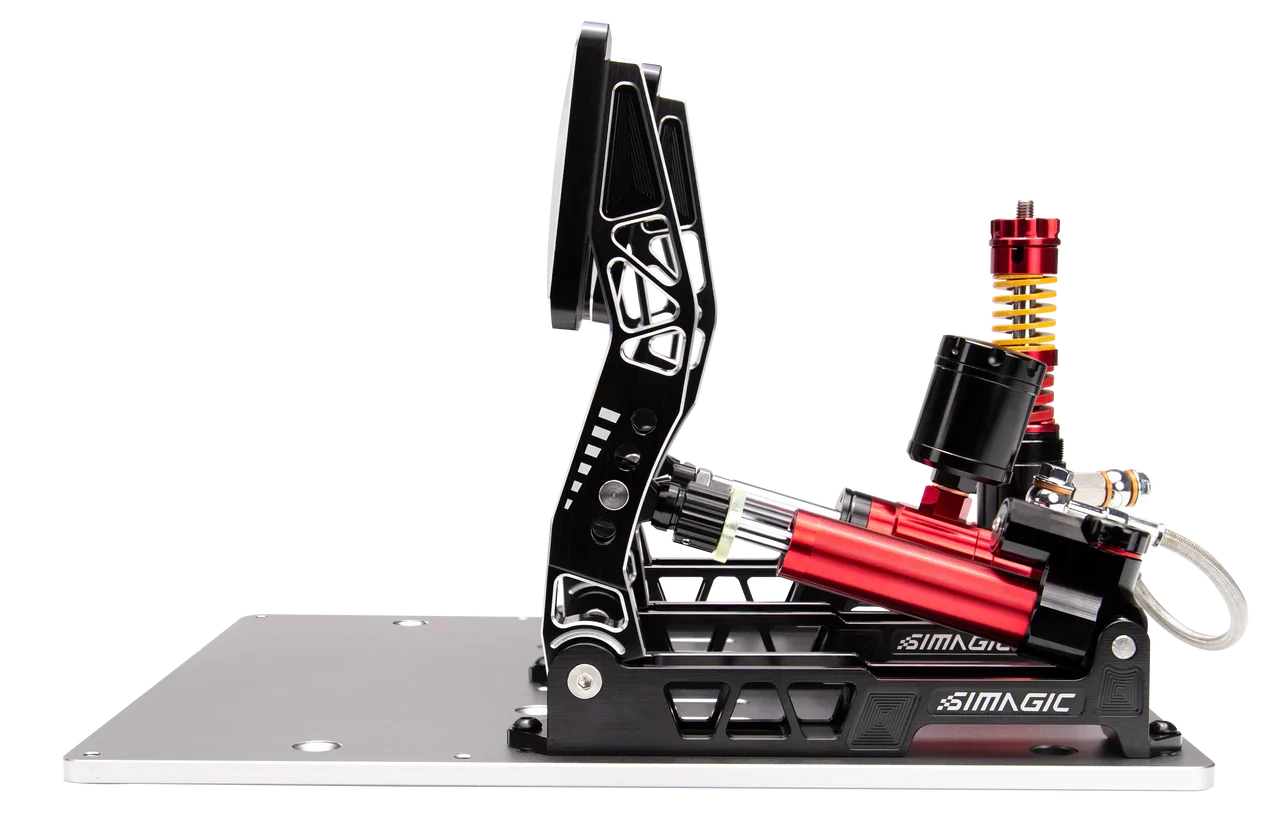
A strain gauge measures the pressure applied, in kilograms. The pedal barely moves: effort is what counts, not travel. This is the standard as soon as you take driving seriously. The Simagic P700 is rated at 150 kg with a complementary Hall sensor; the Simagic P1000 combines Hall angle sensors on throttle and clutch with a 100 kg force sensor on the brake, and accepts an optional hydraulic cylinder.
Hydraulic — pressure
A master cylinder pressurises fluid, exactly like a real braking circuit. Resistance builds progressively then becomes very firm, which gives the closest feel to a race car. The Conspit CPP.LITE is rated at 100 bar, the Conspit CPP EVO V2 at 200 bar with a dual-stage system and a chromed steel piston. The Simagic P2000 includes a hydraulic cylinder and force sensors on all three pedals.
If your current set is fine but the brake lacks character, the standalone CPP EVO V2 hydraulic brake pedal lets you replace only the part that matters.
Pneumatic — cushioned force
An air cylinder replaces the spring or elastomer stack. Air compresses progressively and absorbs shocks: the end of travel becomes cushioned instead of abrupt. That is the signature of SRP pedal sets, the GT-S and GT-R, popular for long stints where calf fatigue eventually costs tenths.
A category of its own now exists: active pedals such as the MOZA mBooster. A servo motor drives resistance in real time and can reproduce ABS, traction control or engine vibration. It is no longer just a sensor — it is an actuator.
Comparison: what each one gives you
| Technology | What it measures | Feel | Who it suits |
|---|---|---|---|
| Hall effect | Pedal position | Long travel, constant resistance. You modulate by distance. | A first pedal set, throttle and clutch, tight budget. |
| Load cell | Applied force, in kg | Short, firm travel. You modulate by effort, as in a real car. | Any driver who wants to improve. The best value upgrade in sim racing. |
| Hydraulic | Circuit pressure, in bar | Progressive build then a firm stop. Closest to a race car. | Regular drivers chasing realism and maximum repeatability. |
| Pneumatic | Force, cushioned by an air cylinder | Soft end of travel, absorbs shocks. | Endurance, long stints, drivers sensitive to calf fatigue. |
| Active pedal | Force, with driven feedback | Resistance varies in real time: ABS, lock-up, vibration. | High-end builds looking for maximum information through the foot. |
Browse the pedal sets
From load cell to hydraulic and pneumatic, with the full technical sheet on each model.
All pedals Simagic Conspit SRPReading kilograms and bars properly
Load cell kilograms
"100 kg" or "150 kg" is the sensor's maximum capacity, not the force you must apply. A 150 kg cell is not harder than a 100 kg cell: firmness comes from springs and elastomers, which can be swapped. A large capacity mainly preserves headroom and linearity at the top of the range.
In practice most drivers brake between 30 and 60 kg, so a 100 kg cell is already generous; 150 kg suits those who set a very firm pedal.
Hydraulic bars
The "max brake factor" is the pressure the circuit can reach. The Conspit CPP.LITE is rated 100 bar, the CPP EVO V2 200 bar. A higher maximum allows a wider adjustment range and a pedal that stays linear even when set very firm. It is headroom, not a number to maximise blindly.
The real criterion, invisible on the spec sheet
Repeatability: the same foot pressure must always produce the same value sent to the game, session after session. That is what lets you build reference points, and it comes from sensor quality, electronics and mechanical rigidity — not from the headline figure.
Tuning: travel, preload and brake curve
A high-end pedal set badly tuned performs worse than a modest one tuned well. Three settings do most of the work.
- Travel. How far the pedal moves before the stop. Short travel favours precision, long travel comfort. Start short on the brake, long on the throttle.
- Preload and firmness. Springs and elastomers are stacked to reach the resistance you want. Set it so your 100 % braking corresponds to an effort you can repeat twenty times without cramping.
- The curve. In the pedal software you define the relationship between effort and the value sent. A slightly progressive curve helps a lot at first: it spreads out the useful braking zone and makes the lock-up threshold easier to find.
Ergonomics matter too: a heel riser or a heel stop stabilises the foot and makes modulation noticeably more consistent. On SRP sets, option kits adjust spacing, angle and footrests.
Mounting and rigidity
A pedal set takes considerable load: braking at 60 kg means pushing the equivalent of a person. If the plate moves, the effort goes into displacement instead of the sensor, and modulation becomes impossible.
- On a rig, bolt the pedals into the intended inserts, never onto a plain board. Aluminium profile rigs have plates adjustable in distance and angle.
- On a wheel stand, check the pedal plate is fixed rather than simply resting, and that it does not slide back under load.
- On the floor, a rigid base plate and a non-slip mat make an enormous difference — the CPP Lite aluminium base plate or the Conspit mat are made for this.
On structure in general, see which sim racing rig to choose.
Two pedals or three?
The third pedal, the clutch, only matters in two cases: you drive manual-gearbox cars with an H-pattern shifter, or you want to practise standing starts. In modern GT, open-wheel and most current categories the clutch is used only at the start — and often through a paddle.
Our advice: start with two good pedals rather than three average ones. Most ranges let you add the clutch later — the Simagic P700 accepts a C-P700 clutch pedal sold separately.
Unsure which technology suits you?
The best way is to brake on all four types in one session. Our demo simulators are deliberately equipped differently.
In-store session Contact usFrequently asked questions
What is the difference between load cell and Hall effect pedals?
A Hall effect sensor measures pedal position: the game receives an angle. A load cell measures the force applied, in kilograms. Because the human body modulates effort far better than distance, a load cell makes braking noticeably more precise and consistent.
Are hydraulic pedals really better?
They are more realistic: resistance builds progressively then becomes very firm, exactly like a real braking circuit, which helps find the lock-up threshold. For a beginner, a good load cell already delivers most of the benefit.
What does a 100 kg or 150 kg sensor mean?
It is the sensor's maximum capacity, not the effort required. Pedal firmness depends on springs and elastomers, which can be changed. Most drivers brake between 30 and 60 kg, so 100 kg is already comfortable.
Can you use pedals from a different brand than your base?
In most cases yes: sim racing pedals connect by USB straight to the PC and appear as a separate device. Some also connect to the base's bus, which frees a port and reduces latency. Check the connection listed on the product page.
Do you need three pedals to start?
No. Unless you drive manual gearboxes with an H-pattern shifter, the clutch is essentially a start-line control. Two good pedals beat three average ones, and a clutch can usually be added later within the same range.
How do you stop pedals from sliding?
The only durable fix is to fix them: bolted to a rig, to a wheel stand's plate, or to a rigid base plate on a non-slip mat. Pedals that move under load make modulation impossible whatever the technology.
Written by the PassionSim team, a Canadian sim racing store. We sell, build and drive this gear every day — send us your questions or come try a simulator in store.