

Last updated: September 2026.
"How many Nm?" is the first question everyone asks about a direct drive base, and it is rarely the right one. Peak torque describes the force a base can produce, not how clearly it talks to you. Two bases quoted at the same figure can feel completely different depending on motor, encoder and electronics. This guide gives you the real scale, the thresholds that matter, and the specifications that weigh more than the newton-metre.
THE SHORT ANSWER
- 5 to 8 Nm: plenty to learn on and enough for most drivers. Force feedback is already complete; only extreme loads are softened.
- 8 to 12 Nm: the most versatile tier. Enough torque to feel understeer without having to upgrade everything else.
- 12 to 18 Nm: for long stints and fine detail under load. Requires a rigid rig, not a desk.
- 18 Nm and above: competition territory and heavy-steering cars. Most drivers never use all of it.
- Torque is not precision: encoder resolution, processing frequency and inertia matter just as much.
Direct drive, belt and gears: the real difference
In a geared wheel, a small motor drives a reduction. It is cheap, noisy, and the teeth introduce backlash that smooths away small signals. In a belt-driven wheel, a pulley replaces the gears — quieter and smoother, but the belt still damps part of the information.
In a direct drive base, the wheel sits on the motor shaft. Nothing remains between the game's calculation and your hands: no backlash, no damping, no delay. That is why a 5 Nm direct drive base can convey more than a belt wheel quoted higher. The question is not belt versus direct drive — that is settled — but which level of direct drive.
What "no cogging" means
An electric motor naturally has magnetic detents that feel like faint notches at low speed. Serious direct drive bases use motors designed to remove them — skew-pole designs at Conspit, ultra-low inertia motors at Simagic. It is a quality criterion at least as important as torque.
What Nm measures — and what it does not
A newton-metre is torque: rotational force applied to the shaft. Roughly, 10 Nm is 10 kg pulled at the end of a 10 cm lever. On a 30 cm rim, that is already more than most people hold comfortably for an hour.
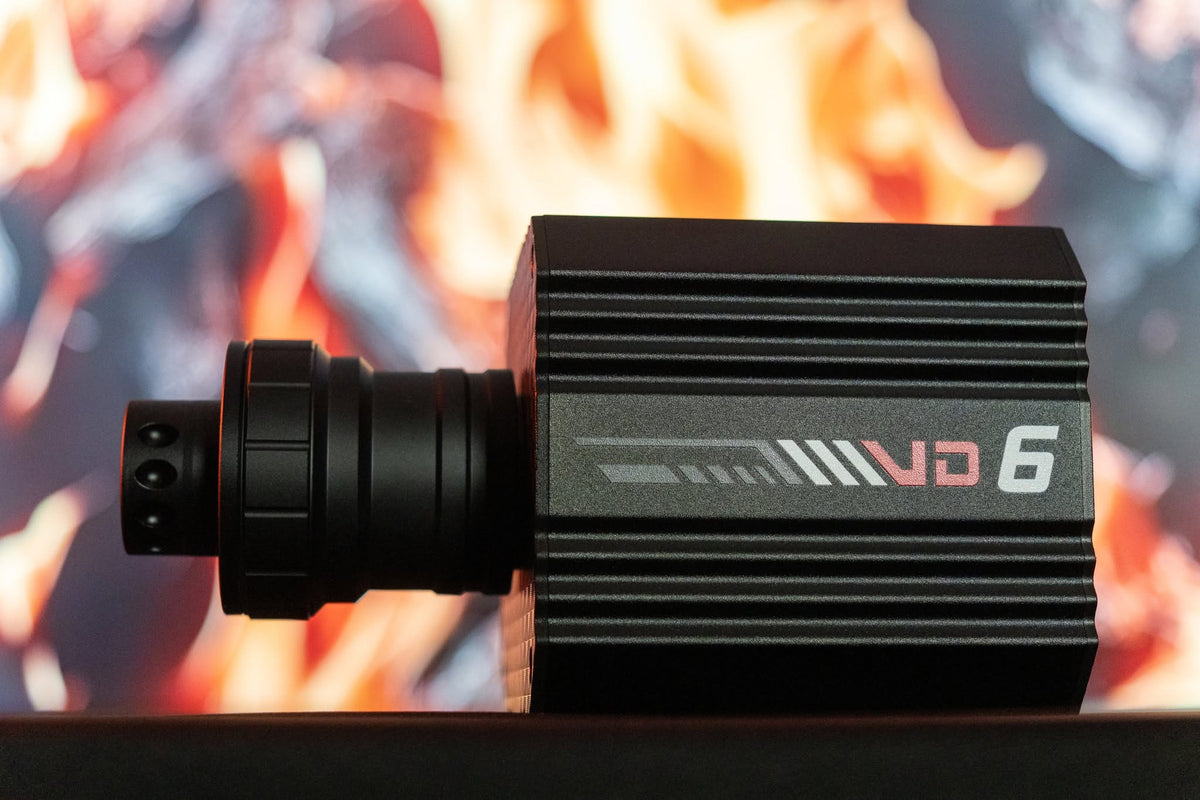
- Peak versus continuous. Some bases quote a peak held for seconds, not a permanent figure. PXN, for example, states both: the VD6 is rated 6 Nm continuous and 7 Nm peak.
- Nobody runs at 100 %. Most drivers set gain between 40 and 70 % of available torque, to keep headroom and avoid clipping fine effects.
- Headroom is the point. A powerful base is not about driving hard all the time; it is about having room for peaks — a kerb, a snap of oversteer — to come through instead of being clipped.
The torque scale, tier by tier

3 to 6 Nm — entry
The way into direct drive. The Moza R3 (3.9 Nm) and the Thrustmaster T598 (5 Nm continuous) sit here, usually bundled with a rim and pedals. The PXN VD6 (6 Nm) does the same on PC. Understeer, oversteer and kerbs all come through clearly. What you lose is the extremes.
8 to 10 Nm — all-round
The best feel-to-constraint ratio, and the tier we recommend most often. The Conspit ARES APEX (8 Nm, 21-bit magnetic encoder, skew-pole motor), the Simagic Alpha EVO Sport (9 Nm) and the PXN VD10 (10 Nm continuous) live here. A serious wheel stand or a light rig still does the job.
12 to 15 Nm — demanding
A real threshold, and not only in power: this is where the structure becomes the limiting factor. The Conspit ARES 12 (23-bit optical encoder, 5.6 kg), the Simagic EVO 12 Nm and the Moza R12 V2 need an aluminium profile or properly bolted tubular rig. The 6SIGMA 6S-80 V2 is rated for bases up to 15 Nm.
18 to 20 Nm — performance
The Simagic EVO Pro 18 Nm and the Conspit ARES Platinum 20 Nm open up very fine textures under high load. Expect real weight — 7.9 kg for the ARES Platinum — and physical fatigue on long stints if you push the gain.
25 to 28 Nm — competition
The Moza R25 Ultra (25 Nm) and the Simagic Alpha EVO Ultra (28 Nm) are for championship drivers, often in heavy-steering cars. At this torque, mounting and emergency stop become genuine safety topics.
Compare direct drive bases
The full range from 3.9 to 28 Nm, with torque, encoder and compatibility listed on every product page.
Direct drive bases Conspit Simagic Moza RacingThe numbers that matter more than torque
| Specification | What it changes | Typical values |
|---|---|---|
| Encoder resolution | How finely the base knows the wheel angle. Higher resolution lets micro-corrections through. | 21-bit is a strong standard; 23-bit (Conspit ARES) goes further. |
| Processing frequency | How fast the processor recomputes force feedback, which governs short effects such as a lock-up. | 180 to 200 MHz on current Simagic bases. |
| Response rate | How often the force loop refreshes. A high rate makes transitions crisp. | 20 to 40 kHz depending on the model. |
| Rotor inertia | A heavy rotor resists direction changes and masks small signals. Low inertia is a major argument. | Look for "ultra-low inertia" or skew-pole motor claims. |
| Latency | Delay between the game's calculation and the force you receive. | Around 5 ms on a well-designed modern base. |
These figures are listed in the technical tab of our product pages. A manufacturer quoting only torque is rarely a good sign.
The practical conclusion: between a 12 Nm base with a mediocre encoder and an 8 Nm base with careful electronics, the second feels better. That is exactly what drivers discover when they try both side by side.
Why the rig is part of the equation
Torque is only felt if it has something to push against. If the base twists, if the mount flexes, if the seat deforms, part of the force disappears into the structure instead of reaching your hands. The symptom is unmistakable: force feedback that feels soft and vague despite a powerful base.
| Base torque | Realistic minimum support |
|---|---|
| Up to 6 Nm | Table clamp on a solid top, or a folding wheel stand |
| 8 to 12 Nm | Reinforced wheel stand, tubular rig, or 40 mm aluminium profile |
| 12 to 18 Nm | 40 to 80 mm aluminium profile, base bolted underneath and on the sides |
| 18 Nm and above | 80 to 120 mm profile, rigid bucket seat, front-mounted base |
Our product pages list the available mounting points — for example M6 × 4 underneath and M8 × 4 on the sides for the Conspit ARES range.
More on this in aluminium profile, tubular rig or wheel stand.
Power supply, quick release and ecosystem
The quick release
The part that connects the rim to the base. Every brand has its own: CDR and CDP at Conspit, QR50, QR70 and QR-A at Simagic, the MOZA QR system at Moza. It decides which rims you can fit tomorrow, so it is the real cost of leaving an ecosystem. Adapters exist, but they add length and sometimes play.
Power supply
The higher the torque, the larger and hotter the power brick. Plan its place and its ventilation in your build. Some high-end bases offer wireless power to the rim, removing a cable across the quick release — the Simagic Alpha EVO range does this.
Emergency stop
Beyond 15 Nm, an emergency stop is not a gimmick. A badly set effect or a game crash can spin the wheel violently. Conspit offers a CES emergency stop compatible with its bases.
Software
MOZA Pit House, Simagic or Conspit Link: each brand has its tuning suite for force curves, steering angle, filters and per-car profiles. A large part of the feel is decided there — far more than in the last five newton-metres.
Three questions to decide
- What will you mount it on? If the answer is "a desk", stay under 8 Nm. If it is an aluminium profile rig, everything is open.
- How long do you drive in one go? Twenty minutes in the evening is not the same as a two-hour endurance race, where fatigue becomes the limit.
- What do you race? A modern open-wheeler with power steering needs little torque; a historic GT or a truck needs far more.
Our most frequent recommendation
For a first serious purchase: an 8 to 12 Nm base, a load cell pedal set and a rigid rig. That combination gives the most enjoyment and progression per dollar, and stays relevant for years.
Not sure which tier?
Come and try. Our demo simulators run bases of different torque levels — ten minutes usually settles it.
In-store session Contact usFrequently asked questions
How many Nm do you need to start sim racing?
Between 5 and 8 Nm is plenty. At that level a direct drive base already conveys understeer, oversteer, kerbs and loss of grip. Extra torque mainly reproduces heavy steering and keeps headroom in the peaks.
Is 8 Nm enough?
Yes for the vast majority of drivers, including experienced ones. Many people who own a 15 or 20 Nm base run gain around 50 %, which is 8 to 10 Nm effective. The difference is decided more by encoder and motor quality.
What is the difference between peak and continuous torque?
Continuous torque is what the base can hold permanently; peak is delivered only briefly. The PXN VD6, for instance, is rated 6 Nm continuous and 7 Nm peak. Always compare the same figure between models.
Does a direct drive wheel work on PS5 or Xbox?
Rarely. Conspit, Simagic and PXN direct drive bases are built for Windows PC. On console you need licensed hardware: the Thrustmaster T598 for PlayStation 4 and 5, the Moza R3 bundle with its ESX rim for Xbox. See our compatibility guide.
Do you need a special rig for 12 Nm or more?
Yes. Past 12 Nm a desk clamp no longer holds properly and flex eats the feel. You need a bolted tubular rig or, better, an aluminium profile rig with the base fixed underneath and on the sides.
Is a more powerful base more tiring?
At maximum gain, clearly — it is real physical effort on the forearms. But nothing forces you to use all the torque: a powerful base set at 50 % is as smooth as a modest one, with more headroom.
Written by the PassionSim team, a Canadian sim racing store. We sell, build and drive this gear every day — send us your questions or come try a simulator in store.